
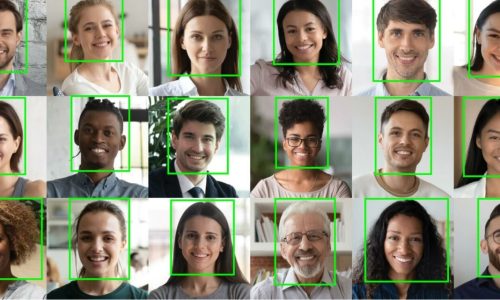
Why is Security and Surveillance Data Annotation Important?

AI-powered surveillance systems depend on high-quality annotated data to:
- Detect suspicious or unauthorized activities.
- Identify and track individuals, vehicles, and objects across camera feeds.
- Recognize safety hazards, crowd formation, or unusual behavior.
- Enhance public safety through predictive threat detection.
- Support law enforcement and emergency response in real time.
Accurate annotation ensures that security AI models can operate effectively in complex, dynamic, and crowded environments — reducing false alarms and improving response speed.
Types of Security and Surveillance Annotation
Video Annotation
Video annotation involves labeling and tracking objects across consecutive frames of surveillance footage. Each moving entity—such as a person, vehicle, or object—is annotated frame-by-frame to train AI models in recognizing motion patterns and detecting specific activities. Techniques like bounding boxes, polygons, and frame linking help in understanding temporal changes, making it essential for intrusion detection, suspicious behavior tracking, and traffic surveillance. Temporal annotation is also applied to mark critical events or time intervals, such as unauthorized access or accidents.
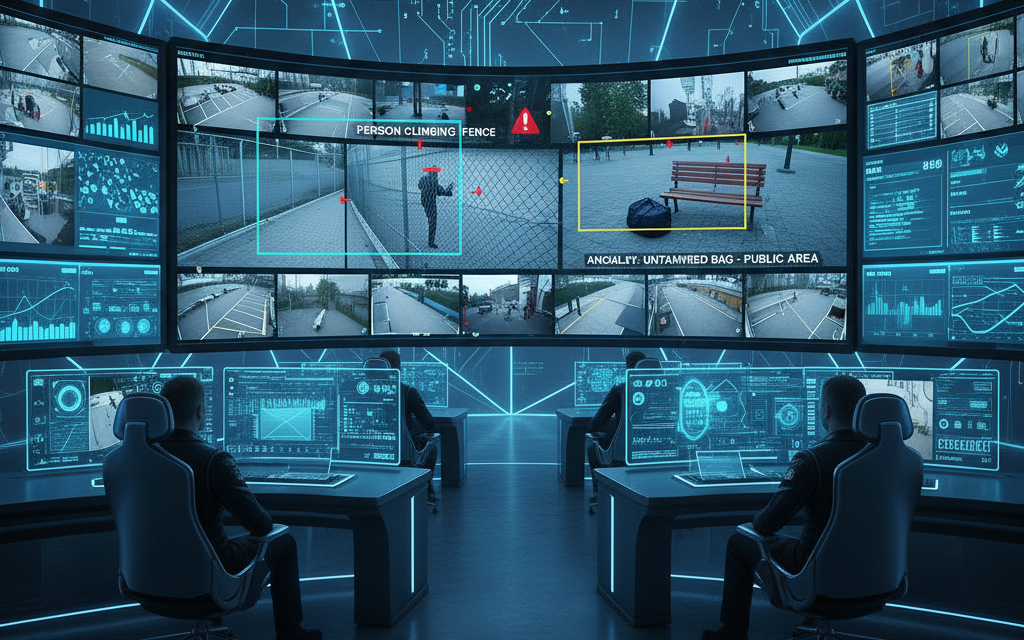
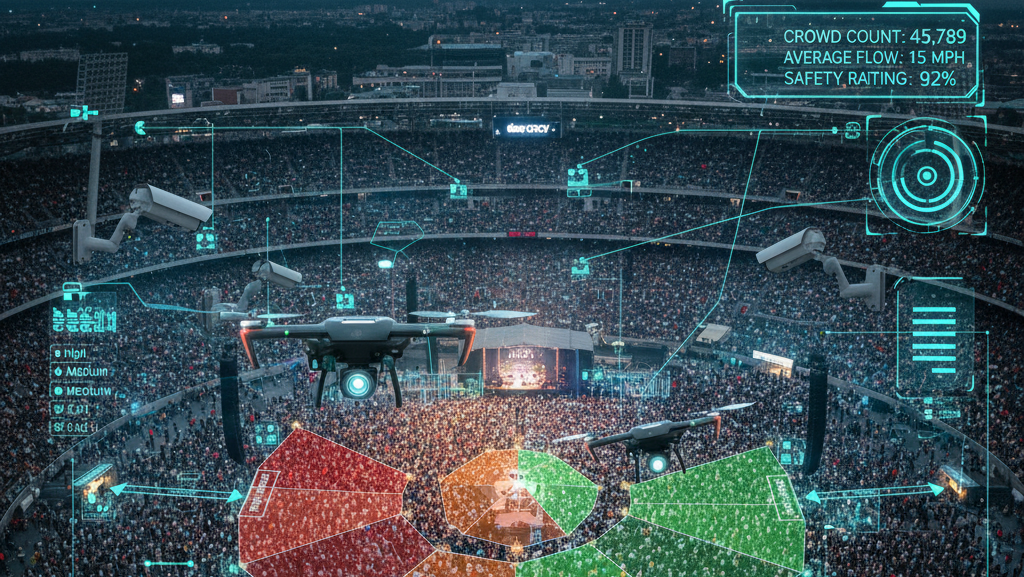
Image Annotation
Image annotation focuses on labeling static frames or still images from security cameras. Bounding boxes and polygons are used to detect and classify key objects like faces, vehicles, weapons, or unattended baggage. Semantic segmentation divides the image into zones—such as restricted areas, walkways, or parking lots—helping AI systems understand spatial layouts. This type of annotation is critical for access control, forensic analysis, and perimeter security systems.
Keypoint and Pose Annotation
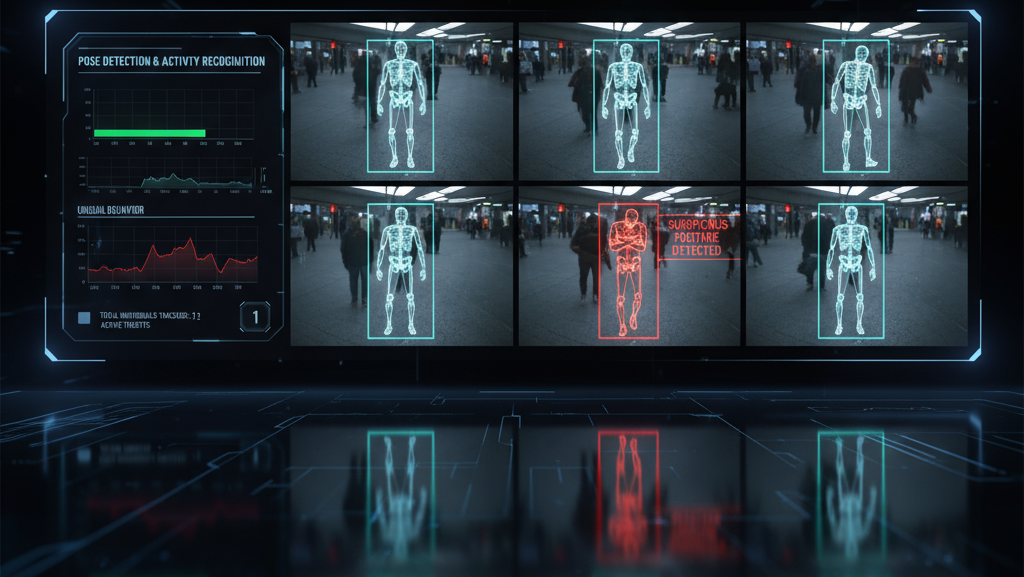
Keypoint and pose annotation is used to map human body positions and movements, marking joints like shoulders, elbows, and knees to understand gestures and posture. This technique helps AI models recognize human behavior patterns—distinguishing between normal and suspicious actions such as running, fighting, or loitering. Pose estimation is especially valuable for crowd management, fall detection, and workplace safety monitoring, where human activity interpretation is key.
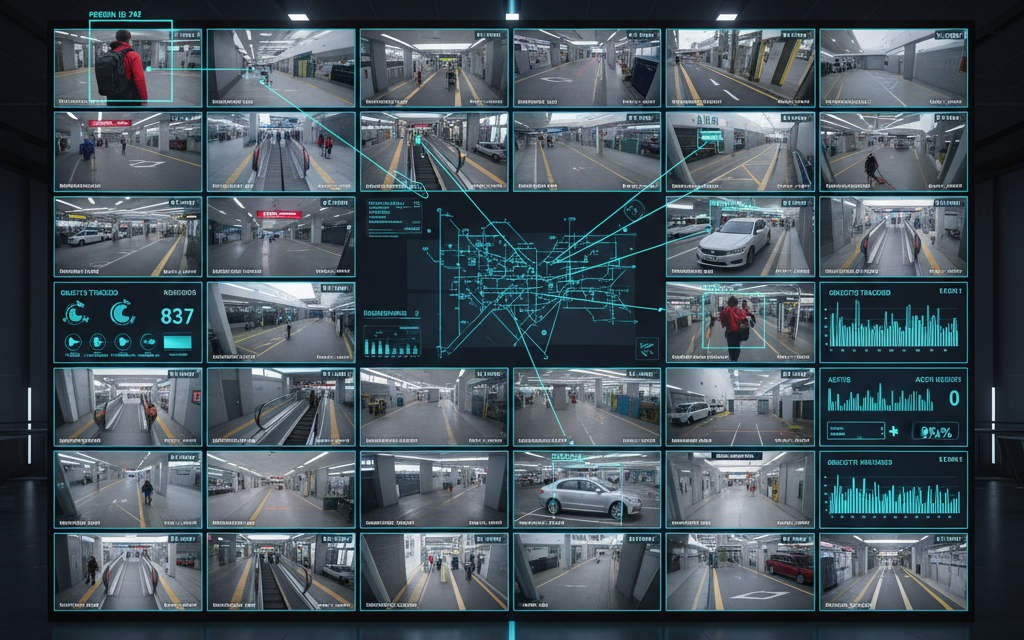
Object Tracking and Re-Identification (Re-ID)
Object tracking annotation links the same object or person across multiple frames or cameras, maintaining consistent identity recognition even under varying lighting or angles. Re-identification (Re-ID) labeling ensures that the same entity is recognized as identical across different surveillance views. This is vital for large-scale surveillance networks, such as airports, city streets, or shopping malls, enabling continuous monitoring of movements and activities in real time.
Security and Surveillance Data Annotation Services
AI-Powered Data Annotation for Intelligent Surveillance Systems
Modern security and surveillance systems use artificial intelligence, computer vision, and machine learning to analyze video footage, identify objects, track movements, and detect unusual activities.
Training these systems requires accurately labeled images and video datasets that represent real-world security environments.
Annotation World provides security and surveillance data annotation services to support the development of AI-powered video analytics and intelligent monitoring solutions.
Our annotation workflows can cover CCTV footage, security camera images, drone surveillance videos, traffic monitoring footage, and other visual datasets.
From object detection and tracking to human activity recognition and pose annotation, we help prepare structured datasets for machine learning and computer vision applications.
Our Security and Surveillance Annotation Services
1. CCTV Video Annotation
CCTV video annotation involves identifying and labeling people, vehicles, objects, and activities across surveillance video frames.
Our video annotation workflows can include:
- Person and vehicle detection
- Object identification and classification
- Frame-by-frame bounding box annotation
- Movement and activity labeling
- Temporal event annotation
- Object tracking across video frames
These annotated datasets can support AI-powered CCTV analytics, access monitoring, and security event detection systems.
2. Image and Object Annotation
Image annotation helps computer vision models recognize and classify objects captured by security cameras and other monitoring devices.
Common annotation categories include:
- People and pedestrians
- Cars, trucks, buses, and motorcycles
- Bags and unattended objects
- Security equipment
- Buildings and infrastructure
- Restricted and designated areas
Annotation methods can include bounding boxes, polygons, and semantic segmentation, depending on the project requirements.
3. Object Tracking and Re-Identification
Object tracking annotation identifies and follows objects across consecutive video frames while maintaining consistent tracking identifiers.
Re-identification annotation focuses on associating the same object across different camera views, where supported by the dataset and project guidelines.
Applications include:
- Multi-object tracking
- Person movement tracking
- Vehicle tracking
- Cross-camera object association
- Entry and exit movement analysis
- Object trajectory labeling
These datasets can support intelligent video analytics and large-scale monitoring applications.
4. Human Activity Recognition Annotation
Human activity recognition annotation involves labeling human actions and movement patterns in surveillance footage.
Depending on the project requirements, annotation categories may include:
- Walking and running
- Sitting and standing
- Falling and unusual movement
- Fighting or physical altercations
- Loitering
- Entering and exiting designated areas
- Group interactions
These labels can support the development of computer vision models for activity classification and event detection.
5. Keypoint and Pose Annotation
Keypoint annotation identifies important body landmarks, including shoulders, elbows, wrists, hips, knees, and ankles.
Pose annotation helps represent human body posture and movement in images and videos.
Potential applications include:
- Human pose estimation
- Gesture recognition
- Fall detection
- Workplace safety monitoring
- Movement analysis
- Human activity classification
6. Intrusion and Anomaly Detection Annotation
Security systems often need to identify events that differ from expected activity patterns.
Annotation workflows can label specific events and temporal intervals according to predefined project guidelines.
Examples include:
- Unauthorized area entry
- Restricted-zone access
- Unattended objects
- Perimeter crossing
- Unusual movement patterns
- Suspicious activity events
These labeled datasets can support machine learning models designed for security event classification and anomaly detection.
An annotation label does not independently establish that a person or activity is suspicious; event definitions must be established by the project owner.
7. Vehicle and Traffic Surveillance Annotation
Vehicle annotation helps AI systems identify and track different types of vehicles in traffic and security camera footage.
Common annotation categories include:
- Cars and motorcycles
- Trucks and buses
- Vehicle bounding boxes
- Vehicle classification
- Vehicle movement tracking
- Entry and exit events
- Traffic flow analysis
These datasets can support traffic monitoring, parking management, and intelligent transportation analytics.
8. Crowd Detection and Monitoring
Crowd annotation involves identifying and labeling groups of people and movement patterns in public and private spaces.
Possible annotation tasks include:
- Person detection
- Crowd density labeling
- People counting
- Crowd movement analysis
- Queue detection
- Congestion identification
- Group activity annotation
These datasets can support crowd analytics and public-space monitoring applications.
Security and Surveillance AI Applications
Accurately annotated datasets can support the development of computer vision and machine learning systems across multiple security applications.
Smart CCTV Analytics
Training datasets for automated object detection, people counting, movement tracking, and event classification.
Airport and Transportation Security
Annotation for monitoring passenger movement, vehicle activity, restricted zones, and security-related events.
Industrial and Workplace Safety
Video labeling for identifying safety equipment, restricted-area access, falls, and workplace activity.
Retail and Commercial Surveillance
Datasets for customer movement analysis, queue monitoring, occupancy detection, and store activity classification.
Perimeter and Facility Monitoring
Annotation for boundary detection, entry and exit events, and object movement around monitored facilities.
Public Space Monitoring
Crowd detection, pedestrian tracking, traffic monitoring, and movement analysis in public environments.
Annotation Techniques for Video Analytics
Different AI surveillance applications require different annotation methods.
Bounding Box Annotation
Bounding boxes identify and locate people, vehicles, and objects within images and video frames.
Polygon Annotation
Polygon annotation outlines irregular objects and specific regions of interest, such as restricted zones and monitored boundaries.
Semantic Segmentation
Semantic segmentation assigns labels to individual pixels to identify objects, surfaces, and environmental regions.
Keypoint Annotation
Keypoint annotation identifies body landmarks to support human pose estimation and activity recognition.
Temporal Video Annotation
Temporal annotation labels events and activities across specific video time intervals.
Multi-Object Tracking
Multi-object tracking annotation maintains consistent object identifiers across video frames to support movement analysis.
Our Security Data Annotation Workflow
A structured annotation workflow helps maintain consistency across security and surveillance datasets.
- Project Assessment – Review video footage, image datasets, annotation objectives, and project requirements.
- Annotation Guidelines – Define object categories, event labels, tracking rules, and annotation specifications.
- Data Preparation – Organize and prepare the supplied images and video datasets.
- Annotation Execution – Perform image labeling, video annotation, object tracking, and other agreed annotation tasks.
- Quality Assurance – Review annotations for consistency, completeness, and adherence to project guidelines.
- Final Delivery – Deliver structured annotated datasets in mutually agreed formats.
Quality Assurance and Data Privacy
Security and surveillance datasets may contain sensitive visual information, including identifiable individuals and private environments.
A responsible annotation workflow should consider:
- Project-specific data handling requirements
- Restricted dataset access
- Secure file transfer procedures
- Appropriate data retention policies
- Privacy-aware annotation guidelines
- Consistency and quality review
- Applicable contractual and legal requirements
Privacy and security controls should be agreed upon with the client before processing sensitive surveillance footage. Any compliance claims must be supported by actual operational controls and applicable certifications.
Why Choose Annotation World?
Annotation World provides data annotation solutions for organizations developing AI and computer vision applications.
Our security and surveillance annotation capabilities can support different data types and labeling requirements, including:
- CCTV and surveillance video annotation
- Image and object labeling
- Human activity annotation
- Object tracking and re-identification
- Keypoint and pose annotation
- Vehicle and crowd annotation
- Temporal event labeling
We focus on structured annotation guidelines, project-specific workflows, and quality review to help prepare datasets for AI-powered surveillance and video analytics applications.
Whether you are developing smart CCTV systems, security monitoring applications, traffic analytics, or computer vision models, our team can discuss an annotation workflow aligned with your project requirements.
Frequently Asked Questions
What is security and surveillance data annotation?
Security and surveillance data annotation is the process of labeling images and videos captured by CCTV cameras, drones, and other monitoring systems to train AI and machine learning models.
What is CCTV video annotation?
CCTV video annotation involves identifying and labeling people, vehicles, objects, and activities across video frames to prepare training datasets for computer vision models.
What types of objects can be annotated in surveillance footage?
Common categories include people, pedestrians, vehicles, bags, security equipment, infrastructure, and other project-specific objects.
What is object tracking in surveillance video?
Object tracking involves identifying an object across multiple video frames and maintaining a consistent tracking identifier to understand its movement over time.
What is human activity recognition annotation?
Human activity recognition annotation involves labeling actions and movement patterns such as walking, running, sitting, falling, and other predefined activities in video footage.
Can surveillance data annotation support intrusion detection AI?
Yes. Labeled events such as restricted-area entry, perimeter crossing, and unauthorized access can be used to train and evaluate AI models designed for intrusion detection.
What annotation techniques are used for security surveillance AI?
Common techniques include bounding box annotation, polygon annotation, semantic segmentation, keypoint annotation, temporal annotation, and multi-object tracking.
How is privacy handled during surveillance data annotation?
Privacy requirements should be defined before processing begins. Appropriate access restrictions, secure data transfer, retention controls, and privacy-aware workflows should be agreed upon based on the dataset and applicable legal requirements.
How can I get started with surveillance data annotation services?
Contact Annotation World with your video or image dataset details, annotation categories, expected volume, and preferred output format to discuss your project requirements.
Get Started with Security and Surveillance Data Annotation
Developing an AI-powered surveillance or video analytics solution?
Annotation World can help prepare structured image and video datasets for object detection, tracking, activity recognition, and intelligent monitoring applications.
Contact our team to discuss your security and surveillance data annotation requirements.