

How Polygon Annotation Works
Polygon annotation is an image labeling technique used to outline objects with multiple connected points. Unlike rectangular bounding boxes, polygons can follow irregular object boundaries more closely, making them useful for image segmentation and computer vision tasks.
AnnotationWorld provides polygon annotation services to help AI teams prepare labeled image datasets for object recognition, segmentation, and other machine learning applications.
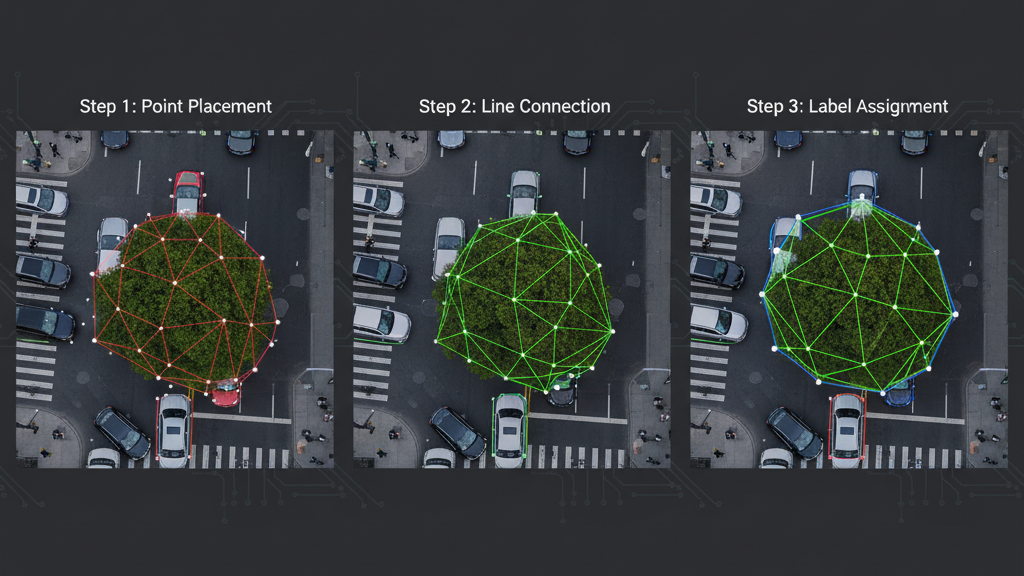
Vertex Placement: Annotators click along the edges of the object to place points.
Line Connection: Each point is connected to form straight lines, ultimately closing the shape.
Class Labeling: The polygon is assigned a class label (e.g., “car,” “tree,” “tumor”).
Verification: The shape is checked to ensure it accurately covers the object without missing edges or including background.
Applications of Polygon Annotation
- Autonomous Vehicles: Labeling irregularly shaped vehicles, traffic signs, pedestrians, and obstacles.
- Medical Imaging: Outlining tumors, organs, or lesions for AI diagnostic models.
- Satellite & Aerial Imagery: Mapping land parcels, buildings, forests, rivers, and roads.
- Retail & Fashion: Annotating products in images for visual search and inventory management.
- Robotics & AR/VR: Detecting and segmenting objects with complex shapes for manipulation or immersive experiences.