
Multisensor Data Annotation for AI and Computer Vision
Multisensor data annotation is the process of labeling and aligning data collected from multiple sensor types to help AI models understand their surroundings. A multisensor system may combine RGB cameras, LiDAR, radar, thermal cameras, and positional sensors to provide complementary information about an environment.
AnnotationWorld provides data annotation services for AI and machine learning projects. Multisensor annotation workflows can be tailored to sensor types, target objects, labeling guidelines, and dataset requirements.
What is a Multisensor System?
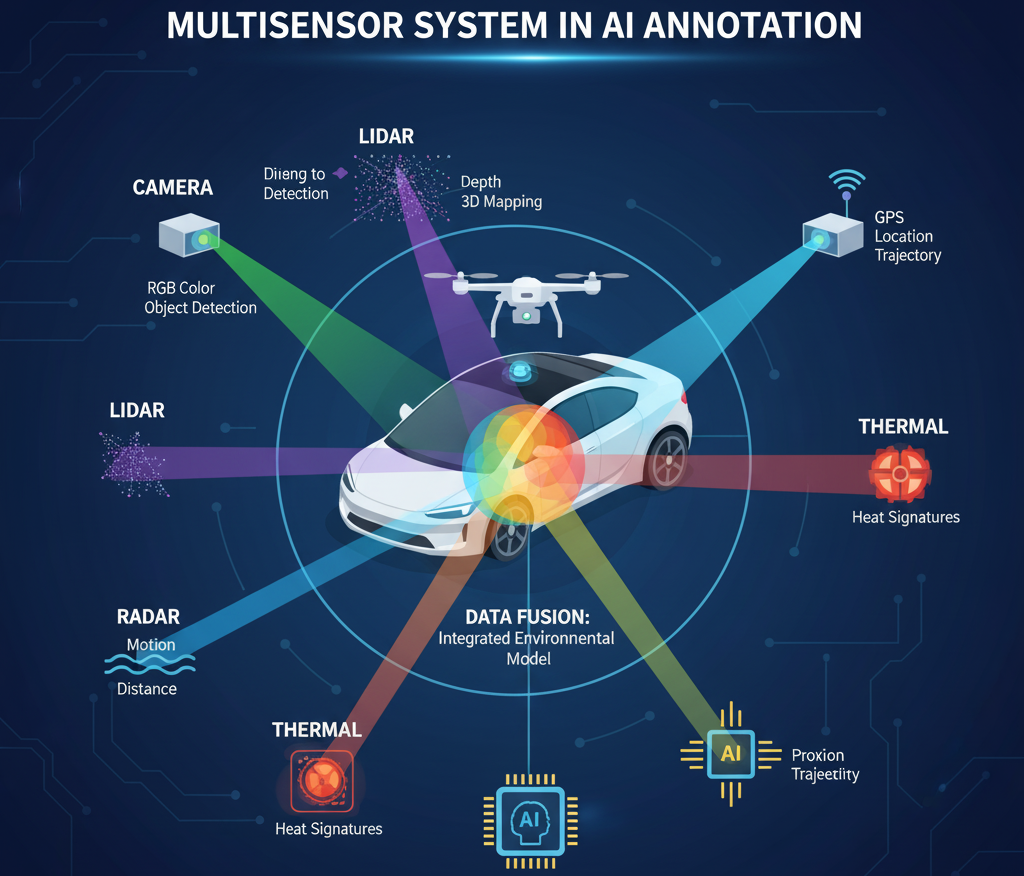
A multisensor system combines data from different sensor types, such as:
- RGB Cameras – capture color images (visual context).
- LiDAR (Light Detection and Ranging) – provides 3D point clouds for depth and distance.
- Infrared/Thermal Cameras – capture heat signatures, useful for night or low-visibility conditions.
- Radar – measures distance and velocity, especially in adverse weather.
- Ultrasonic Sensors – detect close-range objects.
- GPS/IMU Sensors – provide positional and movement data for georeferencing.
By fusing these sensor inputs, a multisensor system can create a comprehensive representation of the environment.
Applications
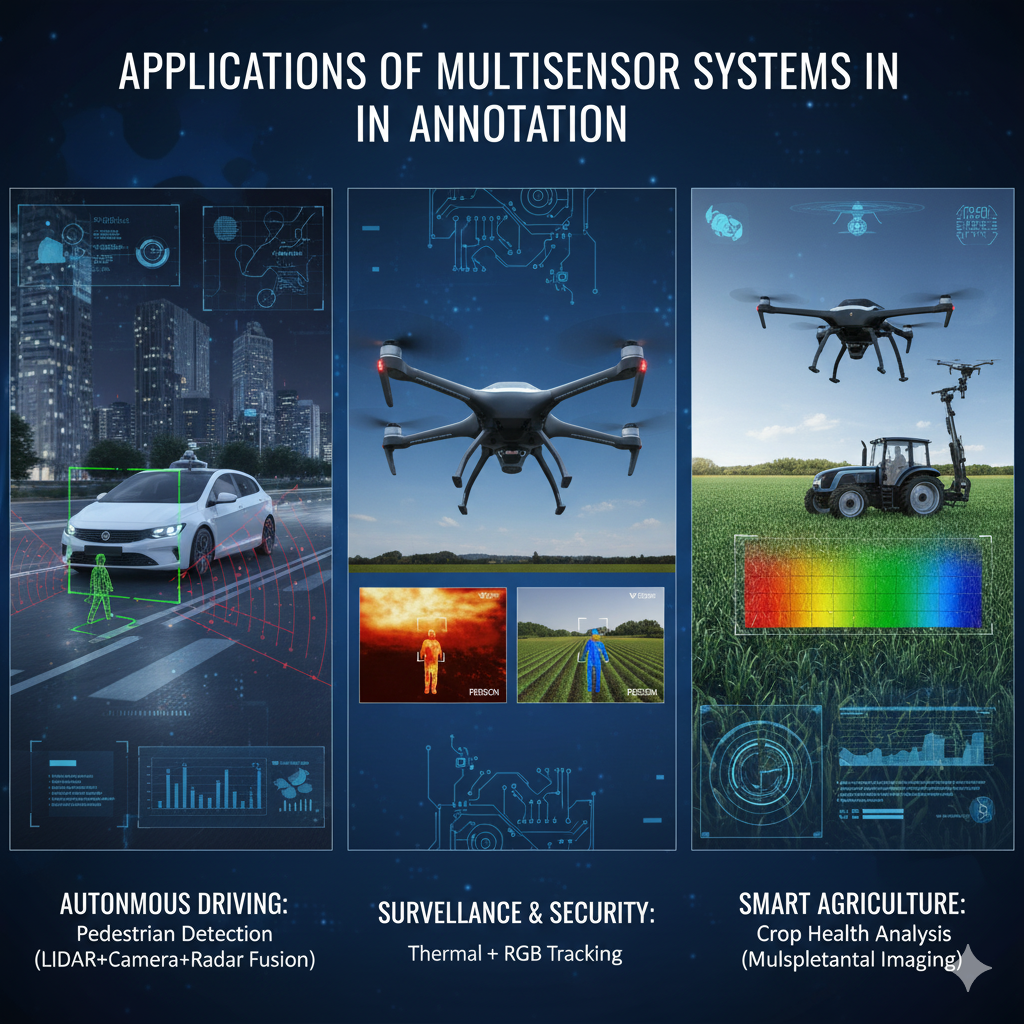
- Autonomous Vehicles: Annotating road scenes using LiDAR, camera, radar, and GPS to detect cars, pedestrians, lanes, and obstacles.
- Surveillance & Security: Fusing thermal, RGB, and infrared to annotate people or suspicious activities in different lighting.
- Agriculture: Combining RGB, multispectral, and LiDAR sensors to annotate crop health, terrain, and irrigation systems.
- Robotics: Annotating 3D maps of indoor/outdoor environments for navigation and obstacle avoidance.
Benefits of Multisensor Data Annotation
Complementary Information: Different sensors provide visual, spatial, motion, or thermal information that can help describe an environment.
Improved Scene Understanding: Properly aligned annotations can help AI models learn from multiple data sources.
Robust Dataset Development: Diverse sensor inputs can support model development across different operating conditions.
Cross-Sensor Validation: Comparing corresponding observations can help identify inconsistencies and missing labels.
The benefits depend on sensor quality, calibration, dataset coverage, and the intended model application.
Quality Control for Multisensor Annotation
A reliable annotation workflow may include:
- Checking timestamp synchronization and coordinate alignment.
- Maintaining consistent object labels across sensor streams.
- Reviewing incorrect or missing cross-sensor associations.
- Validating object locations and relevant measurements.
- Following project-specific labeling and export requirements.
The exact quality checks depend on the sensors, data formats, and project complexity.
Multisensor Data Annotation Services by AnnotationWorld
AnnotationWorld provides data annotation services for AI and machine learning projects. Multisensor annotation requirements can be defined around sensor types, target objects, labeling guidelines, quality criteria, and output formats.
Contact AnnotationWorld to discuss your dataset requirements and determine a suitable annotation workflow.
Frequently Asked Questions
What is multisensor data annotation?
It is the process of labeling and, when required, aligning data from multiple sensors to prepare datasets for AI and machine learning applications.
What is sensor fusion annotation?
Sensor fusion annotation associates relevant information from different sensor sources, such as cameras, LiDAR, and radar, to support combined perception tasks.
Which sensors are used in multisensor systems?
Common sensors include RGB cameras, LiDAR, radar, thermal cameras, ultrasonic sensors, GPS, and IMUs. The combination depends on the application.
Why is sensor synchronization important?
Synchronization helps ensure that observations from different sensors correspond to the same moment or event, improving the reliability of cross-sensor associations.
Which industries use multisensor data annotation?
Applications include autonomous driving, robotics, agriculture, surveillance, smart infrastructure, and industrial automation.