
When structuring computer vision workflows, choosing the right object detection annotation formats can dictate the operational efficiency, model performance, and architectural simplicity of your training pipeline. While newer modeling paradigms regularly emerge, machine learning engineering teams frequently weigh COCO vs Pascal VOC when standardizing data pipelines or integrating historical datasets.
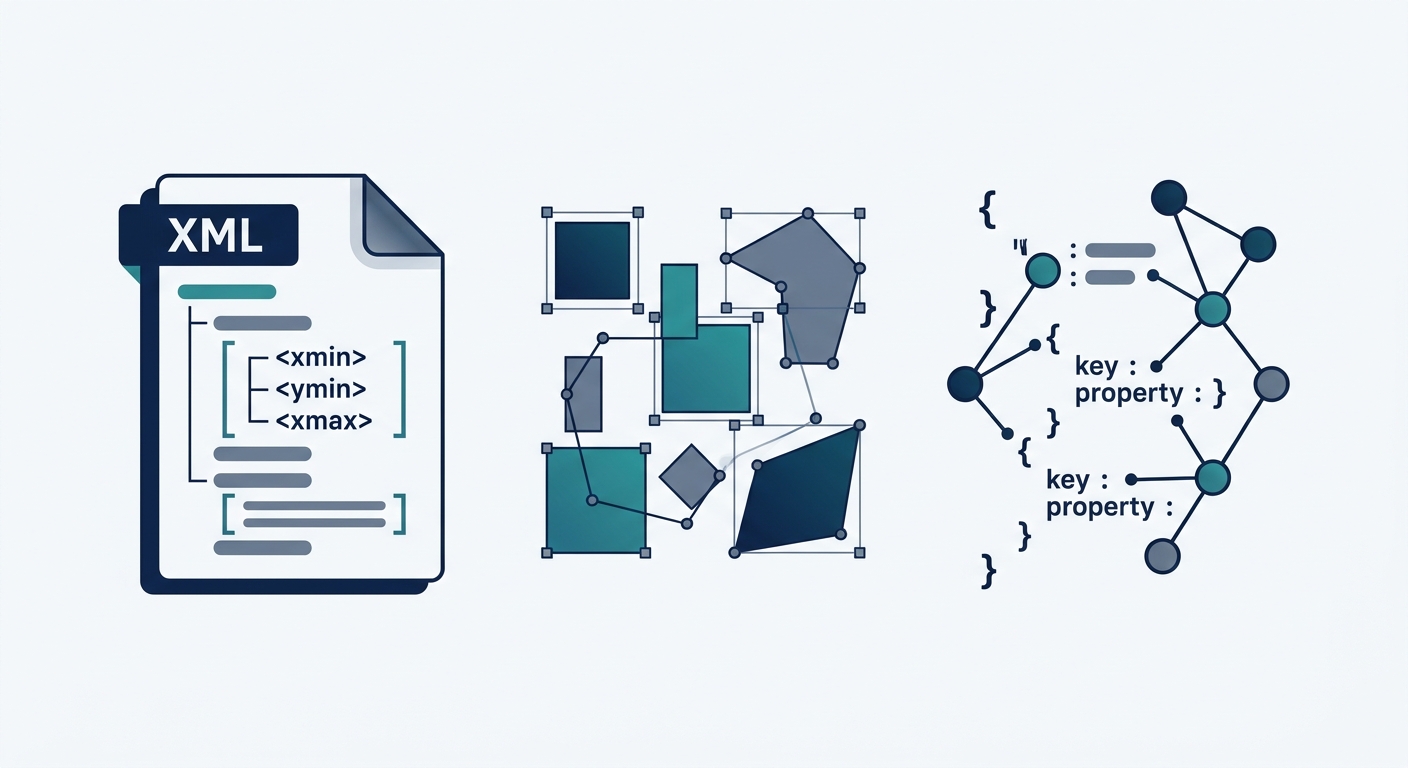
Originating from their respective visual benchmark challenges, the Common Objects in Context (COCO) dataset format and the Pattern Analysis, Statistical Modelling and Computational Learning Visual Object Classes (Pascal VOC) format embody contrasting engineering philosophies. Pascal VOC prioritizes an image-centric, human-readable XML file-per-image architecture, while COCO adopts a centralized, task-versatile JSON graph. Choosing between them—or migrating from one to another—involves critical trade-offs in I/O throughput, localization precision, metric rigor, and enterprise data governance.
COCO vs Pascal VOC: 5 Crucial Architectural Differences
Understanding the technical differences between the Pascal VOC format vs COCO format requires examining how each standard structures geometry, stores metadata, and interacts with distributed training environments.
| Feature | Pascal VOC Format | COCO Dataset Format |
|---|---|---|
| Primary File Format | Per-image XML files (e.g., 000001.xml) |
Single monolithic or split-level JSON file |
| Bounding Box Convention | Corner coordinates: [xmin, ymin, xmax, ymax] |
Origin plus dimensions: [x_min, y_min, width, height] |
| Task Versatility | Primarily 2D bounding boxes and basic segmentation | Bounding boxes, polygons, RLE masks, dense keypoints, panoptic segmentation |
| Default Evaluation Metric | mAP at fixed IoU threshold (0.50) | mAP averaged across IoU thresholds (0.50:0.05:0.95) |
| Storage & Parsing Model | Distributed I/O (millions of individual disk reads) | Centralized index (in-memory parsing or streaming) |
1. Schema Architecture and Parsing Overhead at Enterprise Scale
At an architectural level, the COCO and Pascal VOC data format models handle scale in radically divergent ways. Pascal VOC creates a 1:1 mapping between an image file and an XML annotation file. Each XML document contains the image file name, source path, dimensions, color channels, and nested tags for every labeled object.
In smaller proof-of-concept datasets, an XML file per image allows engineers to inspect and debug individual labels with standard text editors. However, across large enterprise datasets containing hundreds of thousands or millions of images, this design creates significant operational bottlenecks:
- Inode Exhaustion: Filesystems struggle when storing millions of tiny XML files within flat or shallow directories, leading to slow index operations and backup delays.
- I/O Bottlenecks during Ingestion: Training loaders must execute a distinct disk seek and read operation for every single image. Parsing XML with standard libraries like
xml.etree.ElementTreeorlxmlintroduces computational overhead that can starve high-throughput GPU clusters.
Conversely, the COCO format aggregates the entire dataset split (train, validation, or test) into a single, comprehensive JSON document. The schema defines top-level arrays for images, annotations, and categories, linked through relational integer IDs (image_id and category_id).
While this architecture eliminates inode sprawl and allows an entire dataset index to be parsed into memory at once, it introduces a separate challenge: reading multi-gigabyte monolithic JSON files can trigger memory spikes on worker nodes. Enterprise pipelines often address this by sharding COCO JSONs by sequence, batch, or sub-directory, maintaining the JSON format’s relational advantages while preventing memory exhaustion.
2. Coordinate Geometry and Bounding Box Conventions
A frequent source of silent bugs when converting between the Pascal VOC format vs COCO format is how bounding box coordinates are defined and indexed.
Pascal VOC represents bounding box annotation boundaries using two absolute pixel coordinates corresponding to the opposing corners:
[xmin, ymin, xmax, ymax]- Historically, Pascal VOC assumed 1-based pixel indexing rooted in MATLAB conventions, where the top-left pixel is
(1, 1). Modern deep learning tools usually standardize this to 0-based indexing, but legacy datasets may still carry 1-pixel offsets that skew precision.
COCO defines bounding boxes by their upper-left corner and explicit dimensions:
[x_min, y_min, width, height]- COCO operates strictly on 0-based floating-point coordinates. Here,
width = xmax - xminandheight = ymax - ymin.
Feeding VOC-style coordinates directly into a model configured for COCO-style inputs—or vice versa—distorts spatial geometry without immediately throwing execution errors, leading to severe model convergence issues.
3. Task Versatility: Beyond Basic Bounding Boxes
Machine learning workflows often evolve from simple object localization to complex scene parsing. This is where the COCO vs Pascal VOC dataset format divide becomes most pronounced.
Pascal VOC was engineered around 2D object detection and basic pixel-level class segmentation masks stored as indexed PNG files. Extending VOC to support complex topologies, overlapping object boundaries, or fine-grained spatial points requires non-standard XML schema modifications that breaking standard parser compatibility.
COCO was designed from inception as a modular multi-task standard. A single COCO JSON structure natively accommodates:
- Instance Segmentation: Supports both explicit coordinate sequences via polygon annotation and Run-Length Encoding (RLE) masks for complex or disconnected geometries.
- Keypoint Detection: Encapsulates skeletal structures using an array of
[x, y, v]triplets alongside connected bone segment definitions via keypoint annotations. - Stuff and Panoptic Segmentation: Distinguishes countable items (things) from amorphous background regions (stuff) within unified relational schemas.
For modern multi-modal computer vision applications, COCO provides native downstream versatility that Pascal VOC cannot match without extensive customization.
4. Evaluation Metrics: Single-Threshold vs Multi-Threshold mAP
The differences between these formats extend directly into benchmark evaluation protocols. Evaluating a model trained on Pascal VOC data typically relies on mean Average Precision (mAP) computed at a single Intersection over Union (IoU) threshold of 0.50 (often denoted as mAP@0.50 or AP50). The standard VOC protocol calculates the area under the precision-recall curve using an 11-point interpolated sampling method (or continuous integration in later iterations).
While mAP@0.50 measures categorical recognition well, it is forgiving of spatial inaccuracy. A predicted bounding box that loosely overlaps an object by 50% receives full credit as a True Positive.
The COCO evaluation benchmark imposes significantly stricter localization requirements:
- The primary benchmark metric,
mAP@[0.50:0.95], averages the precision across ten distinct IoU thresholds ranging from 0.50 to 0.95 in increments of 0.05. - It categorizes model performance across spatial scales:
AP_small(area < 32² pixels),AP_medium(32² to 96² pixels), andAP_large(area > 96² pixels).
Adopting COCO’s evaluation methodology forces models to predict tighter bounding boundaries and rewards sub-pixel accuracy. Engineering teams working on precision-critical tasks must recognize that converting a pipeline to COCO metrics will yield lower numerical mAP values than VOC metrics on the exact same model, reflecting the stricter localization standard rather than degraded real-world performance.
5. Data Governance, Serialization Integrity, and Pipeline Security
Enterprise AI deployments require robust data integrity, compliance, and lineage tracking throughout the data preparation lifecycle. In production environments operating under ISO 27001 information security frameworks, annotation formats introduce specific architectural risks.
Pascal VOC’s distributed XML structure creates governance vulnerabilities:
- Directory Traversal and Entity Injection: Ingestion pipelines parsing arbitrary XML files from external vendors must defend against XML External Entity (XXE) attacks and malformed path injection in the
<path>tags. - Audit and File Sprawl: Validating that hundreds of thousands of independent XML files have not been tampered with requires generating and storing extensive cryptographic checksum databases across disparate filesystems.
With COCO, a centralized JSON export makes cryptographic signing straightforward: a single SHA-256 hash verifies dataset integrity across millions of annotations. Furthermore, JSON parsers avoid XML-specific injection vulnerabilities. However, because a single corruption event in a monolithic JSON file can invalidate the entire dataset, data governance teams must enforce automated schema validation (such as strict JSON Schema verification) within CI/CD data ingestion pipelines.
Converting Legacy Pascal VOC Pipelines to COCO Format
Many machine learning teams maintain legacy systems utilizing Pascal VOC annotations. Migrating to modern vision frameworks—such as MMDetection, Detectron2, or newer Ultralytics architectures—often requires standardizing on COCO JSON.
When building automated conversion scripts, ensure your migration logic accounts for these technical requirements:
- Category Mapping Normalization: VOC files store class names as arbitrary strings inside
<name>tags. Build a deterministic category dictionary that maps unique strings to 1-indexed integers (e.g.,{"dog": 1, "cat": 2}) to populate the COCOcategoriesarray. - Coordinate System Conversion: Read the VOC corner coordinates (
xmin,ymin,xmax,ymax) and calculate dimensions explicitly:width = xmax - xminandheight = ymax - ymin. Calculate area aswidth * heightto populate the required COCOareafield. - Image Identity Decoupling: Extract the filename from the XML’s
<filename>element, read the raw image metadata to verifywidthandheight, and assign an immutableimage_idinteger. Avoid relying on file system sorting order, which can vary across host environments. - Handling Occlusion and Difficulty Flags: VOC XML includes
<difficult>and<truncated>elements. Map these directly to COCO’siscrowdflag (wheredifficult=1can map toiscrowd=1to omit the instance from standard evaluation calculations) or preserve them as custom fields inside anattributessub-dictionary.
Which Format Best Serves Your Production Roadmap?
Selecting between the COCO and Pascal VOC data format standards depends on your hardware infrastructure, model architecture, and annotation density.
Choose Pascal VOC if:
- You maintain existing production models trained on legacy object detection backbones that natively ingest XML.
- Your labeling operations focus exclusively on sparse 2D bounding boxes, and your training environment prefers loading annotations directly alongside individual images.
- Human reviewers require immediate, isolated text-editor validation of specific single-image files without loading larger dataset indices.
Choose COCO if:
- Your computer vision roadmap includes instance segmentation, pose estimation, keypoints, or multi-task learning.
- You run high-throughput distributed training on modern deep learning frameworks that optimize I/O via consolidated metadata indices.
- You require granular model evaluation that penalizes poor localization across varying object scales (
mAP@[0.50:0.95]). - You operate within strict enterprise compliance frameworks where centralized data signing, auditability, and ISO 27001 data governance standards are paramount.
For organizations scaling computer vision initiatives, partnering with an experienced data annotation provider eliminates format fragmentation and serialization errors at the source. At Annotation World, our ISO 27001-certified data labeling services deliver production-ready datasets structured precisely to your framework’s required schema, whether you rely on COCO JSON, Pascal VOC XML, or custom multimodal representations.
Frequently Asked Questions
Can Pascal VOC format store polygon annotations for instance segmentation?
Standard Pascal VOC stores bounding boxes in XML files and instance masks as separate PNG image files where pixel values map to class or instance IDs. It does not natively support polygon vertex arrays inside the XML schema without custom tags that break compatibility with off-the-shelf parsers.
Why does COCO format use [x, y, width, height] instead of [xmin, ymin, xmax, ymax]?
COCO’s design represents an object’s spatial position as an origin coordinate (x, y) combined with its spatial extent (width and height). This structure simplifies calculating aspect ratios, bounding box scale, and area, while maintaining consistency with common 2D graphics frameworks.
Does converting VOC to COCO improve model accuracy?
The conversion itself does not improve accuracy, as the underlying bounding box coordinates remain geometrically identical. However, standardizing on COCO unlocks modern neural network architectures and multi-threshold evaluation metrics that guide better hyperparameter tuning and model optimization.