
Selecting the right software for dataset preparation often dictates the speed and quality of computer vision deployments. Engineering teams evaluating open source annotation tools frequently encounter two venerable platforms: CVAT (Computer Vision Annotation Tool) and LabelImg. While both have helped train thousands of object detection models, they serve fundamentally different operational scales and technical requirements.
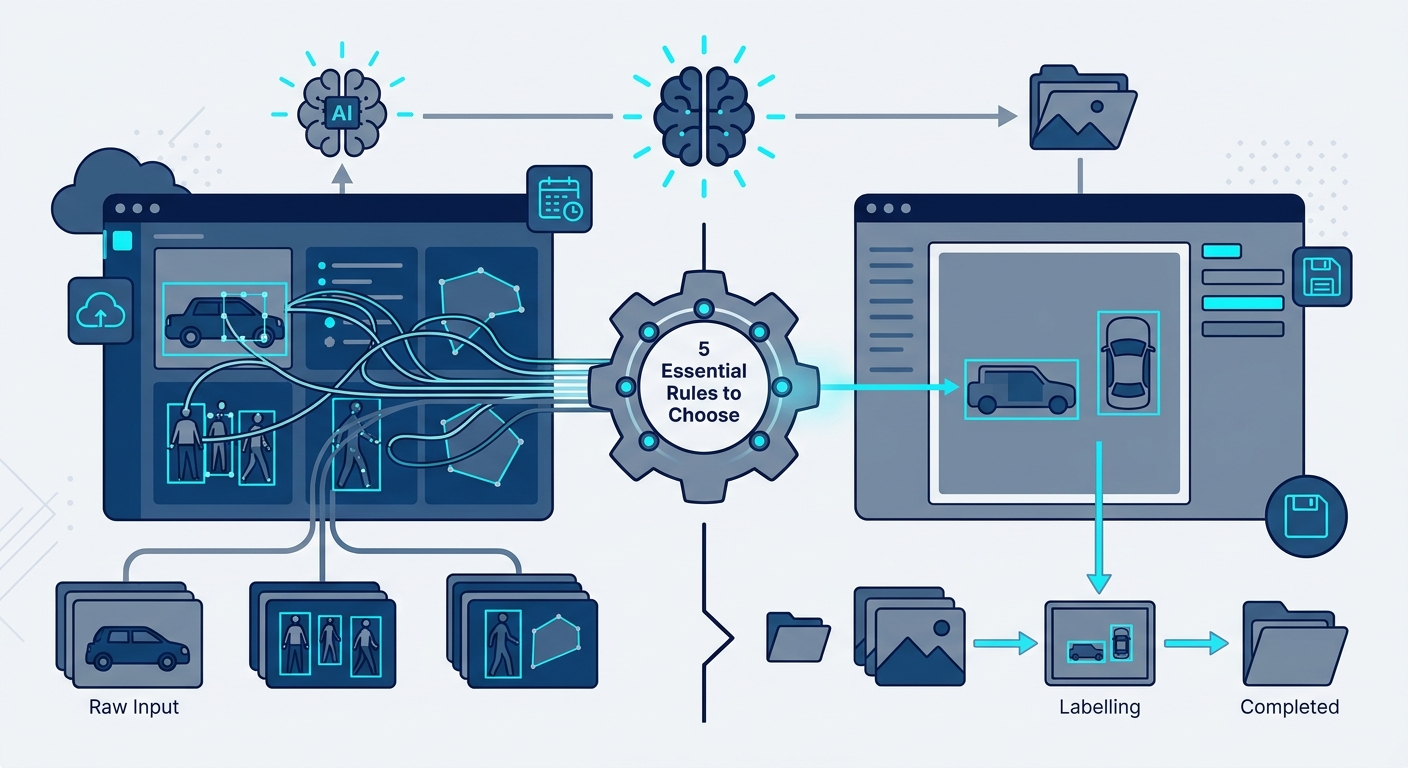
LabelImg emerged as an accessible desktop application built with Python and Qt, whereas CVAT was engineered as a robust, client-server web platform capable of handling enterprise-grade computer vision tasks. Understanding the trade-offs between these utilities will prevent engineering bottlenecks, tooling rework, and compliance oversights.
CVAT vs LabelImg: Key Architectural Differences
Before assessing deployment criteria, it is essential to understand how each tool functions under the hood. Their underlying architecture dictates how data is stored, processed, and accessed by annotators.
| Feature Dimension | LabelImg | CVAT |
|---|---|---|
| Architecture | Local desktop client (Python/PyQt) | Client-server web application (Docker/Django/React) |
| Supported Formats | Pascal VOC XML, YOLO TXT, CreateML | COCO, Pascal VOC, YOLO, TFRecord, MOT, datumaro, and more |
| Annotation Types | 2D Bounding boxes only | Boxes, polygons, polylines, points, cuboids, masks |
| Video Annotation | No native support (requires frame extraction) | Native support with object tracking and interpolation |
| Multi-User Collaboration | None (isolated desktop instance) | Role-based access control, task assignments, reviews |
| Model-Assisted Labeling | No | Yes (integrated via serverless functions / Nuclio) |
Rule 1: Assess Solo Prototyping vs. Team-Based Collaboration
The primary decision rule centers on the operational structure of your labeling project. When comparing labelimg vs cvat, individual engineers working on quick proof-of-concept (PoC) tasks have drastically different requirements than distributed annotation teams.
LabelImg shines in frictionless, offline setups. If a single researcher needs to tag 300 images stored on a local drive to fine-tune an initial detection model, LabelImg requires minimal setup. It runs locally without managing databases or background daemons. However, this simplicity breaks down immediately when multiple annotators are introduced. Collaborating in LabelImg requires manually partitioning file directories, emailing zip archives, or managing Git branches for XML files—an error-prone approach that leads to label drift and overwrites.
CVAT, by contrast, is built for structured collaboration. It provides workspaces, multi-tier roles (annotator, reviewer, supervisor), and task assignment pipelines. Annotators receive designated chunks of a dataset, supervisors review submissions via integrated quality control stages, and project leads inspect real-time progress metrics. If your roadmap involves two or more annotators, CVAT’s shared server architecture becomes a baseline requirement.
Rule 2: Determine Geometries and Video Tracking Demands
Your model’s target architecture dictates the required label geometry. Choosing a tool incapable of supporting your label specifications forces engineers to write brittle preprocessing shims.
- Bounding Boxes: LabelImg is strictly a bounding box annotation tool. It does not support arbitrary shapes, keypoints, or line annotations.
- Complex Geometries: Computer vision workflows targeting instance or semantic segmentation require polygon or mask drawing tools, which are natively available in CVAT.
- Temporal Continuity: For autonomous systems and surveillance, continuous frame sequences require tracking IDs. LabelImg lacks video capabilities, forcing teams to decompose videos into individual frame images, losing temporal context. CVAT offers specialized video recording and labelling interfaces featuring automatic linear interpolation, optical flow tracking, and persistent object IDs across frames.
Rule 3: Evaluate Performance at Dataset Scale
Dataset scale exposes significant differences between localized desktop software and scalable web platforms. When reviewing discussions around cvat vs labelimg github repositories, dataset bottlenecks are frequently highlighted.
LabelImg loads images directly into local system memory through its PyQt canvas. When directories exceed several thousand high-resolution files, users often experience sluggish navigation, input lag, and unexpected software crashes. Because it operates entirely on client storage, sharing labeled data requires external synchronization tools.
In contrast, CVAT offloads heavy lifting to a backend server. Video files and large image sets are segmented into manageable chunks and decompressed asynchronously. CVAT supports direct connections to cloud storage buckets (Amazon S3, Google Cloud Storage, Microsoft Azure Blob), allowing annotators to label petabyte-scale repositories without downloading raw assets to their local machines. For official documentation on configuring distributed storage nodes, consult the CVAT official documentation.
Rule 4: Review Security, Audit Trails, and Compliance Standards
Data governance is frequently overlooked in early-stage ML experiments, but it becomes critical when handling proprietary intellectual property, protected health information (PHI), or personally identifiable information (PII).
While LabelImg processes data locally without transmitting packets to the cloud, it provides zero auditability. There are no access logs, user authentication mechanisms, or encryption standards enforced at rest or in transit. This leaves sensitive data vulnerable on local laptops or uncontrolled network shares.
Deploying CVAT within a private VPC or an on-premises data center allows teams to integrate enterprise identity providers (LDAP/OAuth), enforce strict role-based permissions, and log all user actions. Organizations adhering to regulatory frameworks like ISO/IEC 27001 require structured controls over data modification, access revocation, and infrastructure hardening. When self-hosting CVAT, your internal DevOps team assumes complete responsibility for continuous security patching, database backups, and network perimeter protection.
Rule 5: Define Your Long-Term Annotation Scaling Path
While open source annotation tools provide initial cost savings, they also introduce significant infrastructure overhead. Self-hosting CVAT at scale requires ongoing maintenance: provisioning GPU workers for automated labeling, orchestrating Docker containers, resolving database migrations, and training annotators.
When model requirements grow from thousands to hundreds of thousands of annotations, the total cost of ownership (TCO) for self-hosted software often eclipses initial projections. Machine learning leads must decide whether to continue managing annotation infrastructure or transition to external production pipelines.
If maintaining internal labeling stacks distracts your engineers from core algorithm development, partnering with managed data annotation services allows your team to receive verified, audit-ready training data under enterprise Service Level Agreements (SLAs), backed by verified ISO 27001:2013 information security standards.
Frequently Asked Questions
What is CVAT in data annotation?
CVAT (Computer Vision Annotation Tool) is a free, web-based, open-source tool developed to label digital images and videos for machine learning. It supports diverse computer vision tasks, including object detection, semantic segmentation, keypoints, and 3D point cloud labeling, complete with team management workflows and semi-automated annotation.
What is the LabelImg tool?
LabelImg is a lightweight, graphical image annotation desktop application written in Python. It uses Qt for its graphical interface and allows users to quickly generate 2D bounding boxes for object detection, saving files primarily in Pascal VOC XML and YOLO text formats.
Which is better, Roboflow or CVAT?
The choice depends on your pipeline’s scope. Roboflow is an end-to-end commercial platform focused on dataset hosting, preprocessing, augmentation, and model deployment for computer vision. CVAT is a dedicated annotation engine that excels in fine-grained manual labeling, dense video interpolation, and custom on-premises enterprise deployments.
What are the two main types of annotation?
In the context of computer vision and machine learning, data annotation is broadly split into spatial annotation (locating objects via bounding boxes, polygons, keypoints, or pixel-level segmentation masks) and semantic annotation (assigning contextual labels, tags, or categorical attributes to whole scenes or identified entities).