
When machine learning engineers start their first object detection pipeline, the discussion around tooling frequently begins on forums like GitHub and r/MachineLearning. Search for a lightweight, open source computer vision labeling tool, and two names inevitably appear: CVAT (Computer Vision Annotation Tool) and LabelImg. While both have played major roles in the history of computer vision training pipelines, the tooling landscape has shifted dramatically.
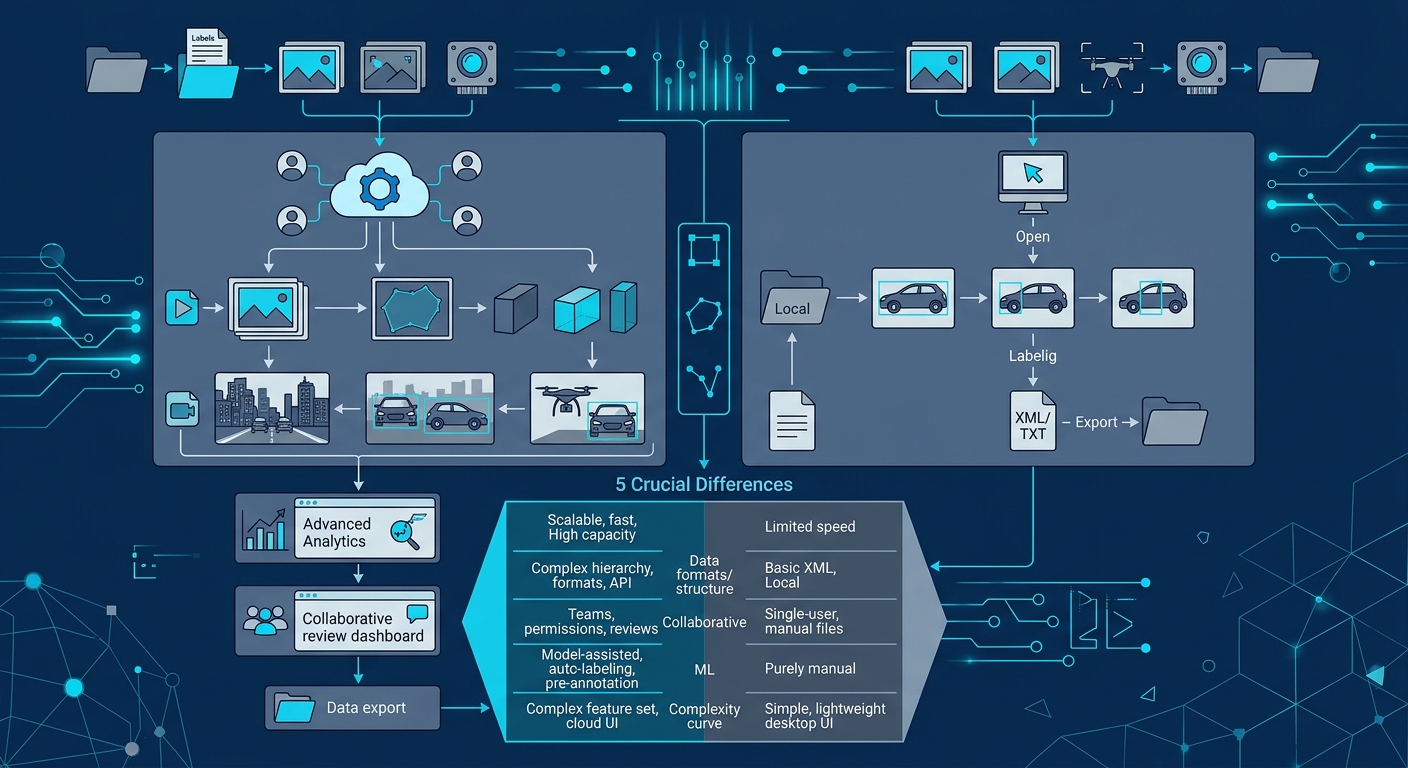
If you are deciding between CVAT vs LabelImg for your team’s workflow in 2026, the short answer is straightforward: one is an evolving, full-featured platform with foundation-model integrations, while the other is an archived legacy script. Choosing between them is less about personal preference and more about project scale, security posture, and engineering return on investment.
The Core Breakdown: CVAT vs LabelImg
To understand why these tools serve fundamentally different needs, look at their architecture, feature sets, and maintenance status side by side:
| Feature / Dimension | CVAT | LabelImg |
|---|---|---|
| Project Status | Actively maintained by CVAT.ai and open-source contributors | Officially deprecated and archived on GitHub |
| Supported Modalities | Images, continuous video, multi-spectral, 3D point clouds | Static 2D images only |
| Annotation Types | Bounding boxes, polygons, polylines, points, cuboids, masks | Rectangular bounding boxes only |
| AI Assistance | Native Segment Anything Model (SAM), interactive tracker models | None (purely manual coordinate dragging) |
| Deployment | Client-server web architecture (Docker, cloud, or on-premise) | Local desktop standalone script (Python / PyQt) |
| Multi-User Collaboration | Role-based access, task assignment, reviewer stages | None (single user working on local directory) |
| Export Formats | COCO, Pascal VOC, YOLO, TFRecord, CVAT XML, and 20+ more | Pascal VOC XML, YOLO text, CreateML |
1. Maintenance Status and Ecosystem Health
The most critical divergence between the two tools is project lifecycle. LabelImg, originally created by Darren Tzutalin, was officially archived on GitHub. Development stopped, pull requests are no longer merged, and users are officially advised by its maintainers to migrate to modern tools such as Label Studio. While you can still clone the repository or install it via Python package managers, doing so leaves your pipeline vulnerable to unpatched dependencies, Qt framework bugs, and operating system incompatibilities.
In contrast, CVAT remains one of the most widely adopted open source image annotation tools. Originally incubated at Intel and now stewarded by CVAT.ai alongside an active community, CVAT receives regular releases. It integrates modern computer vision research, continuously patches container vulnerabilities, and maintains support for up-to-date Python runtimes and database engines.
2. Geometry Support: Beyond Simple Bounding Boxes
LabelImg was designed around a single, highly constrained task: drawing rectangular 2D bounding boxes to generate Pascal VOC or YOLO format coordinates. If your target task is basic object detection on isolated images, that narrow focus makes it simple to run. However, modern computer vision projects rarely stop at simple boxes.
CVAT provides comprehensive multi-task labeling right out of the box:
- Segmentation: Complex multi-vertex polygons and pixel-level binary masks for semantic segmentation and instance segmentation.
- Lines and Keypoints: Skeletal tracking and keypoint annotations for human pose estimation or facial landmark tracking.
- Multi-Sensor & 3D: Point cloud annotation with 3D cuboids, essential for robotics and perception systems.
Attempting to run an advanced segmentation or lane-detection project with LabelImg is impossible without switching software mid-stream.
3. Video Annotation and AI-Assisted Workflows
Annotating high-frame-rate video represents a massive cost center for vision teams working on autonomous vehicles and surveillance systems. LabelImg treats videos as disconnected folders of extracted JPEG frames. An annotator must re-draw or manually adjust a box on frame 1, frame 2, and frame 100 independently, creating massive time sinks and jittery tracking data.
CVAT approaches video natively. It includes linear and non-linear interpolation engines: an annotator draws an object in frame 1, defines its location in frame 30, and CVAT calculates the intermediate bounding coordinates automatically. Furthermore, CVAT integrates foundation models like the Segment Anything Model (SAM) and OpenCV trackers via its serverless function backend (Nuclio). Annotators can click an object once, let SAM derive a pixel-perfect mask, and propagate that mask through subsequent frames using deep learning trackers—cutting manual labeling time by up to 70%.
4. Scalability, Architecture, and Enterprise Security
Architecture defines how well a tool scales within an organization. LabelImg operates entirely locally. To distribute work, someone must split image folders, zip them, send them to contractors or junior engineers, and manually merge messy XML files back into a central repository. This introduces substantial operational hazards:
- No Audit Trail: There is no native version history, quality control dashboard, or mechanism to measure inter-annotator agreement.
- Data Leakage Risks: Raw proprietary images must sit directly on local drives of labeling staff or outsourced contractors.
For organizations operating under strict data governance standards like ISO/IEC 27001, local desktop file-sharing is an unacceptable risk. CVAT uses a client-server architecture deployed via Docker. Images remain secured inside private cloud buckets (AWS S3, Azure Blob, Google Cloud Storage) or behind on-premise firewalls. Team leads can assign tasks, enforce role-based access controls (RBAC), and review annotations through integrated approval queues without sensitive data ever being downloaded to personal workstations.
5. The ROI Equation: Open-Source Tools vs. Managed Services
A recurring topic in threads discussing cvat vs labelimg reddit communities highlight is hidden operational overhead. Engineering leaders often assume that using free open-source tools means zero labeling cost. In practice, the total cost of ownership (TCO) changes dramatically as datasets grow from hundreds of images to hundreds of thousands.
| Dataset Phase | Ideal Tooling Strategy | Primary Cost Driver |
|---|---|---|
| Prototyping (< 1,000 images) | Local tools or CVAT sandbox | Engineer time (drawing boxes manually) |
| Benchmarking (1,000 – 25,000 images) | Self-hosted CVAT cluster | DevOps setup, server maintenance, QA tracking |
| Production Scaling (50,000+ images) | Managed Annotation Workforce + Enterprise Platform | Workforce management, pipeline drift, QA SLA adherence |
Hosting and maintaining CVAT at scale requires dedicated DevOps resources: managing GPU instances for AI-assisted microservices, monitoring storage bandwidth, and troubleshooting database bottlenecks. More importantly, using high-salary machine learning engineers or data scientists to manually draw boxes or supervise freelancers inside self-hosted software is an expensive misallocation of technical capital.
When model performance plateaus due to noisy labels or edge-case scarcity, transitioning to an ISO 27001-certified managed labeling partner delivers superior ROI. Professional annotators operate within calibrated QA loops, adhere to tight project delivery schedules, and handle complex edge cases across LiDAR, multi-spectral video, and medical imagery—freeing your engineering team to focus on model architecture and deployment.
Frequently Asked Questions
What is CVAT in data annotation?
CVAT (Computer Vision Annotation Tool) is a web-based, open-source platform designed to annotate digital images and continuous video for machine learning. It supports diverse tasks, including object detection, semantic and instance segmentation, keypoints, and 3D cuboids, and features server-side AI integrations for accelerated labeling.
Which is better, Roboflow or CVAT?
It depends on your workflow requirements. Roboflow is an end-to-end commercial computer vision platform focused on dataset management, dataset health analytics, augmentation, and model training deployment. CVAT is primarily a dedicated, specialized annotation suite that excels at complex frame-by-frame video interpolation and granular manual labeling controls. Many teams use CVAT or CVAT alternatives for labeling, then ingest data into Roboflow or custom training pipelines.
Is CVAT free to use?
Yes. CVAT’s core software is open source under an MIT-style permissive license and can be deployed freely on your own local machines or cloud servers via Docker. CVAT.ai also provides hosted cloud subscriptions with free tiers for basic usage and paid tiers for team collaboration and expanded cloud storage.
What is CVAT used for?
CVAT is used across industries—including autonomous vehicles, geospatial mapping, retail analytics, and healthcare—to prepare supervised ground-truth data for computer vision models. It enables engineering teams to create bounding boxes, segmentation masks, and tracking IDs on large multi-camera video feeds and high-resolution imagery.