
In supervised machine learning, dataset quality and scale dictate production performance. However, human labeling remains one of the largest financial and operational bottlenecks for enterprise AI programs. High-throughput projects requiring complex tasks—such as 3D point cloud tracking, multi-class named entity recognition, or semantic segmentation—can quickly exhaust development budgets if teams default to brute-force annotation across entire raw data pools.
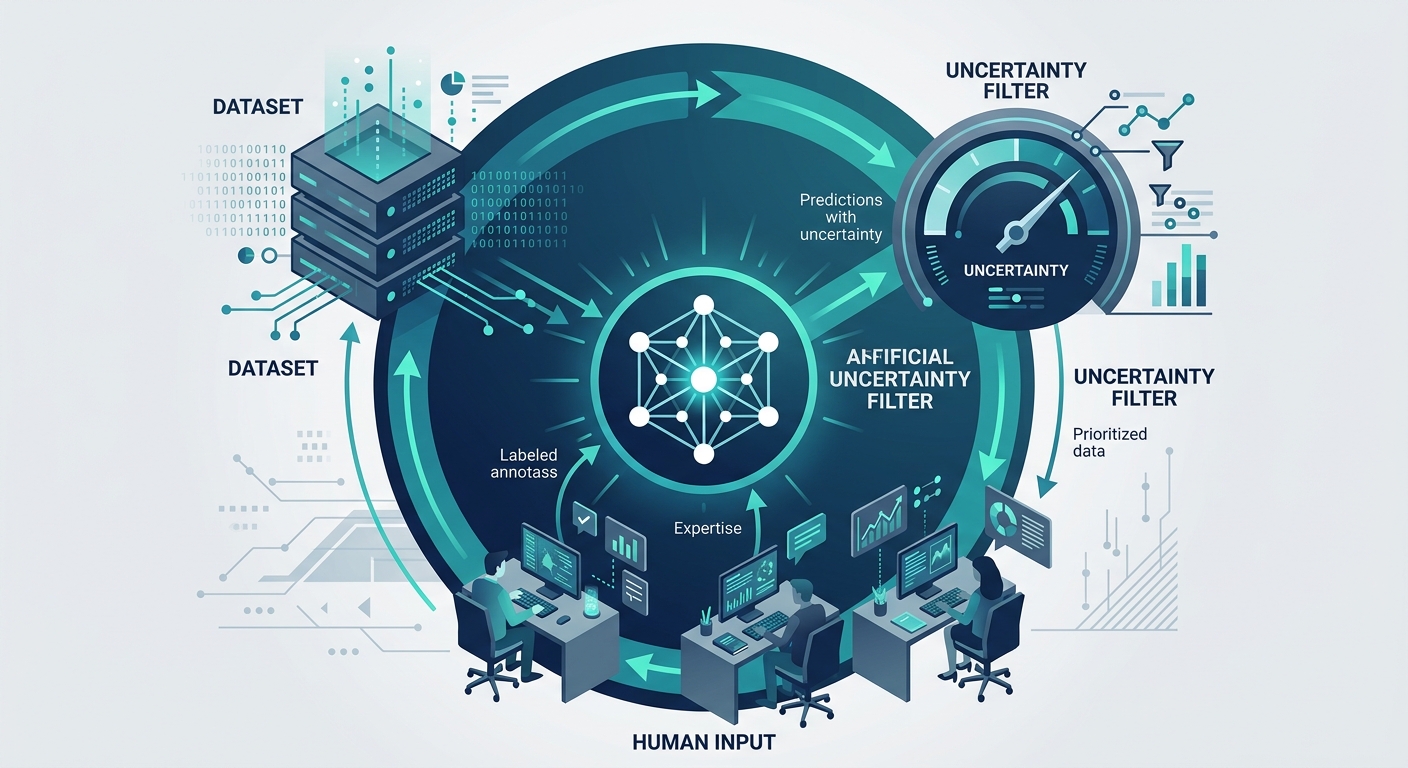
Adopting active learning for data annotation fundamentally changes this dynamic. Instead of labeling every incoming record uniformly, machine learning teams use algorithmic query strategies to identify and annotate only the most informative samples. When combined with experienced human-in-the-loop (HITL) annotators, active learning allows engineering teams to reach high model accuracy targets while reducing total labeling volume, vendor spend, and cycle times.
How Active Learning for Data Annotation Works
In standard passive learning, models train on randomly selected or sequentially gathered datasets. This often introduces extreme data redundancy: a highway camera captures thousands of nearly identical empty road frames, or customer support logs record thousands of repeated baseline greetings. Human annotators spend billable hours validating examples that provide zero novel gradient signal to the neural network.
Active learning in machine learning transforms this passive workflow into a dynamic, closed-loop system. An initial model—trained on a small, curated seed set—evaluates a pool of unlabeled data and ranks each record based on an acquisition function. The samples identified as most valuable are then routed to professional annotators. Once labeled, these high-utility examples return to the training pool, the model retrains, and the cycle repeats.
5 Proven Ways Active Learning for Data Annotation Cuts Costs
1. Prioritizing Informative Samples via Uncertainty Sampling
Uncertainty sampling is the most direct way to eliminate wasted annotation spend. Instead of paying specialists to review high-confidence samples, the algorithm queries data points that fall near the model’s current decision boundaries. Common mathematical formulations include:
- Least Confidence: Prioritizes samples where the model’s highest predicted class probability is lowest: 1 – P(y*|x).
- Margin Sampling: Calculates the difference between the top two predicted class probabilities. A narrow margin indicates ambiguity between competing classes.
- Entropy Sampling: Evaluates overall prediction distribution dispersion across all classes. Higher entropy signifies widespread uncertainty.
By routing only ambiguous inputs to annotators, teams ensure every dollar spent on labeling targets model weakness rather than reinforcing existing capabilities.
2. Eliminating Redundancy with Density-Based Diversity Sampling
Pure uncertainty sampling has a known failure mode: it tends to oversample outliers, sensor artifacts, and unrepresentative noise. Teams counter this by deploying active learning with sampling by uncertainty and density for data annotations.
Density sampling maps candidate records into a latent embedding space and measures local data density using clustering algorithms (such as k-means or core-set selection). The acquisition function then balances high uncertainty with high representativeness:
Score(x) = Uncertainty(x) × Density(x)
This composite scoring prevents teams from spending budget on random anomalies that do not generalize to real-world inference distributions, ensuring the resulting training set remains compact and mathematically diverse.
3. Accelerating Workflows with Model-Assisted Pre-Annotation
An effective active learning pipeline for automatic annotation uses the current checkpoint model to generate pre-annotations (such as bounding boxes or text spans) for incoming high-confidence data, while reserving full manual labeling for uncertain regions. Open-source annotation engines like Label Studio support integrating custom inference backends directly into human review interfaces.
Reviewing and correcting an AI-generated polygon or span is significantly faster than drawing or tagging from scratch. For high-density tasks like autonomous driving scene parsing or biomedical text extraction, pre-labeling combined with targeted human validation can cut annotator handling time per asset by 30% to 50%.
4. Targeted Hard Negative Mining for Rare Edge Cases
In production safety tasks—such as detecting debris on roads for autonomous vehicles or rare defects in industrial manufacturing—standard random sampling requires labeling hundreds of thousands of negative instances just to capture a statistically viable set of rare positive events.
Active learning acts as an automated triage layer. By querying samples where the model exhibits high epistemic uncertainty or false-positive confusion, active learning surfaces difficult negative samples (hard negatives) and anomalous edge cases directly from vast unlabeled data lakes. Engineering teams stop paying for the curation of standard baseline data and direct human expertise strictly toward critical operational failure points.
5. Identifying and Eliminating Label Noise Early
Noisy ground-truth labels degrade model convergence and inflate annotation costs through repeated re-work. Active learning algorithms naturally detect noisy labels: when a model repeatedly struggles with high uncertainty on an already-labeled instance, that instance frequently contains an ambiguous guideline interpretation or an outright human tagging error.
Systematically routing these divergent samples back to senior annotators or consensus QA queues prevents corrupted data from entering regression pipelines, preserving model training stability and preventing downstream retraining costs.
Comparing Uncertainty vs. Diversity Sampling: Computer Vision vs. NLP
Sampling strategies do not perform identically across data modalities. Below is a practical comparison between computer vision (CV) and natural language processing (NLP) deployments.
| Dimension | Computer Vision (CV) | Natural Language Processing (NLP) |
|---|---|---|
| Primary Feature Space | Convolutional / Vision Transformer embeddings (e.g., CLIP, DINOv2) | Transformer token embeddings (e.g., RoBERTa, modern LLM representations) |
| Uncertainty Mechanics | Spatial entropy across pixels (segmentation) or box-level class/IoU confidence | Sequence-level perplexity, token-level margin sampling, or Monte Carlo dropout |
| Diversity Bottlenecks | Visual background shifts, lighting variations, high-dimensional pixel noise | Vocabulary drift, syntactic variations, domain-specific semantic ambiguity |
| Best-Performing Strategy | Core-set selection combined with margin sampling over object proposals | Density-weighted sequence entropy combined with cosine similarity clustering |
In computer vision tasks like bounding box annotation, relying solely on uncertainty often leads models to sample visual noise such as lens glare or rain reflections. Applying core-set diversity constraints ensures the selection covers diverse lighting conditions, camera angles, and object densities. Conversely, in NLP, combining sequence entropy with semantic clustering prevents over-indexing on repetitive domain jargon or slight spelling variations.
Step-by-Step Framework: Active Learning for Data Annotation Tutorial
Integrating active learning with an enterprise-grade annotation workforce requires a structured, multi-stage architecture. Below is a production blueprint for setting up the loop.
- Seed Dataset Creation: Curate a high-quality, balanced seed dataset (typically 2% to 5% of your target total volume). Have professional annotators label this seed set using multi-pass consensus to establish an uncompromising baseline ground truth.
- Baseline Model Training: Train your initial model checkpoint using established libraries like scikit-learn for tabular/classical models or PyTorch/Hugging Face for deep architectures. Evaluate on a fixed, high-integrity golden test set.
- Inference & Uncertainty Calculation: Run the model across the unlabeled data lake. Compute uncertainty metrics (entropy, margin, or least confidence) for every record.
- Diversity & Density Filtering: Extract vector embeddings from the model’s penultimate layer. Apply clustering or nearest-neighbor distance metrics to filter the top uncertain candidates, removing near-duplicate samples and unrepresentative outliers.
- Batch Triage & Human Labeling: Package the selected query batch and transmit it to your annotation provider. Annotation teams work within strict SLA and quality guidelines (such as ISO 27001-certified environments for data security and privacy) to return labeled data.
- QA, Ingestion & Retraining: Ingest the newly labeled batch into your versioned feature store, run automated validation checks, retrain the model, and evaluate against the golden test set. Repeat until validation metrics reach deployment thresholds.
Quantitative Impact: Labeling Cost and Time Breakdown
To quantify the real-world impact of active learning versus traditional random sampling, consider a typical enterprise project targeting 100,000 raw candidate inputs for multi-class entity classification or defect segmentation:
| Metric | Standard Passive Annotation | Active Learning Pipeline | Observed Savings |
|---|---|---|---|
| Total Assets Manually Labeled | 100,000 | 35,000 | 65% reduction in volume |
| Average Handling Time (AHT) per Asset | 45 seconds | 28 seconds (via pre-labeling) | 37.7% faster per asset |
| Total Annotator Billable Hours | 1,250 hours | 272 hours | 78.2% reduction in labor hours |
| Model Accuracy Target (F1 Score) | Achieved at 100k samples | Achieved at 35k samples | Parity achieved 3.6x faster |
| Downstream Compute & Storage | Full dataset hosting & epochs | Curated dataset footprint | Lower training GPU overhead |
By focusing human intelligence strictly on high-impact records, enterprise teams achieve faster model velocity and minimize recurring data processing overhead.
Handling Edge Cases and Label Noise in Active Learning
Because active learning systematically surfaces edge cases, it requires robust safeguards to keep noisy data from poisoning model training:
- Distinguishing Epistemic from Aleatoric Uncertainty: Epistemic uncertainty stems from a lack of training data and resolves when humans provide labels. Aleatoric uncertainty stems from inherent sensor noise, occluded imagery, or ambiguous phrasing that humans cannot reliably resolve. Use Monte Carlo dropout or ensemble models to isolate epistemic uncertainty before sending batches to human annotators.
- Consensus Arbitration: Implement automated confidence scoring on incoming annotator submissions. If an annotator’s label contradicts a moderately confident model prediction, route the sample to a multi-annotator consensus workflow or an expert reviewer.
- Dynamic Guideline Updates: Active learning rapidly exposes gaps in annotation guidelines. Maintain a centralized feedback loop between your ML engineers and the labeling operations team to update edge-case resolution rules every iteration.
Frequently Asked Questions
Can you give me an example of active learning in machine learning?
A clear example is training a document classification system for medical records. Out of 500,000 raw clinical notes, labeling all files manually is cost-prohibitive. The team annotates a seed batch of 1,000 documents and trains an initial classifier. The model evaluates the remaining 499,000 files and calculates prediction entropy. It identifies 5,000 records containing rare diagnostic terms where its confidence is low and class margins are razor-thin. Annotators label only those 5,000 challenging records. Retraining on this targeted batch yields performance gains comparable to labeling 50,000 random documents.
How difficult is it to get hired by data annotation companies?
Hiring standards depend on the domain. General tagging roles require high attention to detail and reading comprehension, while specialized domains—such as medical pathology, ADAS point cloud segmentation, or multilingual LLM code evaluation—require proven technical backgrounds and domain expertise. Candidates undergo rigorous screening assessments evaluating accuracy, speed, and adherence to edge-case guidelines.
How do I pass the data annotation test?
To pass an annotation assessment, read the project guidelines thoroughly before reviewing the data. Top evaluation criteria include precision in edge placement (for vision tasks), consistency in boundary detection, correct tagging of ambiguous edge cases, and zero tolerance for missed target classes. Following project-specific conflict resolution rules is more important than rushing through samples.
What skills to put for data annotation?
Key skills include familiarity with labeling platforms (such as CVAT, Label Studio, or Roboflow), domain-specific knowledge (such as medical terminology, GIS, or programming languages), geometric precision for computer vision tasks, linguistic analysis skills for NLP, and an understanding of data security standards such as ISO 27001 and GDPR.
Scaling machine learning systems requires balancing high data quality with disciplined budget management. If you are preparing to scale your AI pipeline and need rigorous, security-compliant labeling workflows, contact our annotation specialists to design a cost-efficient human-in-the-loop strategy tailored to your model requirements.