
Deep learning models are notoriously prone to memorizing mislabeled samples. When training data contains label noise deep learning models often overfit to erroneous annotations, degrading inference accuracy, distorting model calibration, and destabilizing convergence. While architectural adjustments like noise-tolerant loss functions help, engineering teams realize that sustainable model improvement requires data-centric remediation at the pipeline level.
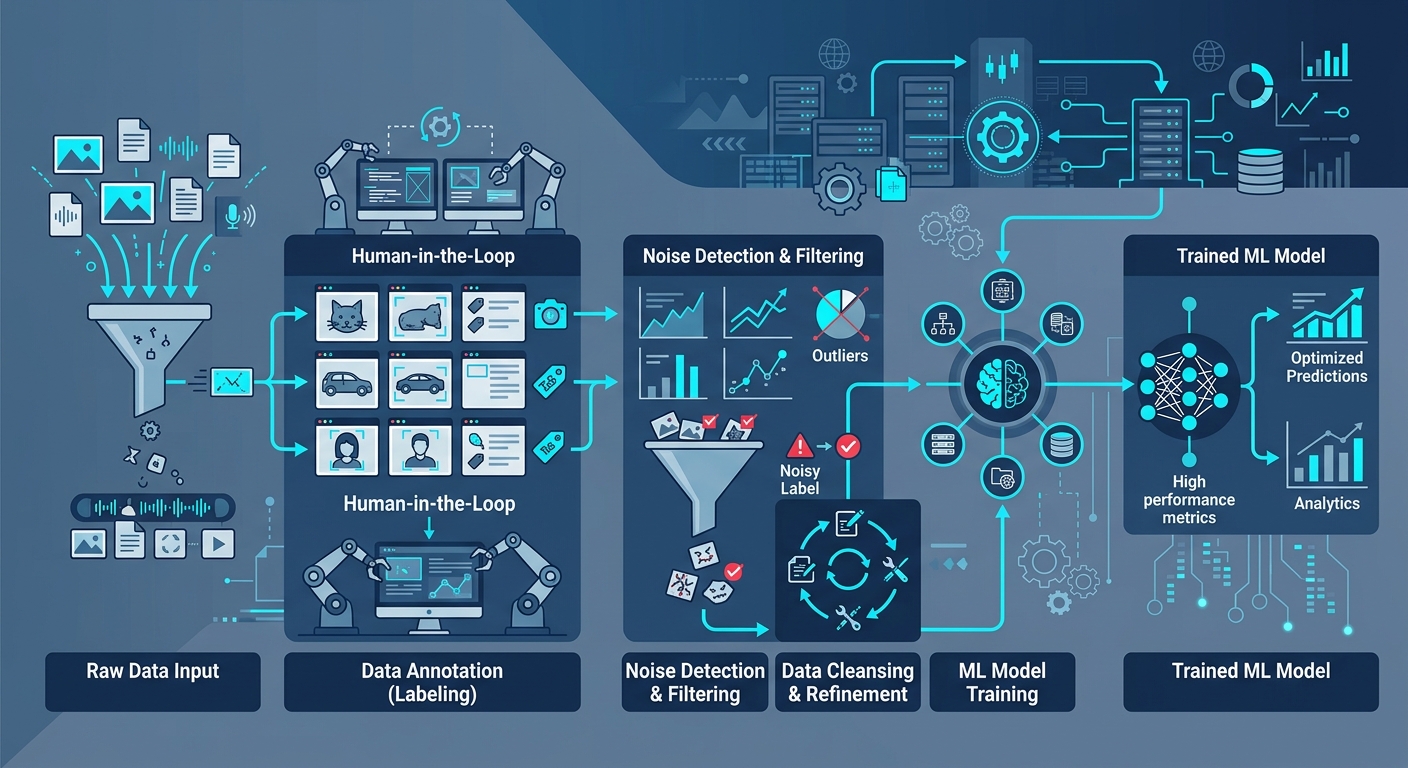
Understanding how to handle noisy labels in machine learning datasets requires tackling the problem at two inflection points: fixing latent errors during ingestion and preventing annotation degradation at the source. Below are five proven strategies to identify root causes, reconcile errors across modalities, and systematically purge label corruption from training corpora.
Understanding Noisy Labels: Root Causes Before Model Ingestion
Label noise is rarely completely random. In production workflows, errors typically split into two categories: symmetric (independent of features, such as accidental click errors) and asymmetric (feature-dependent, such as visual ambiguity between adjacent classes). Identifying why errors occur during production prevents recurring pipeline contamination.
- Ambiguous Taxonomy Definitions: When guideline boundaries between classes (e.g., distinguishing “dented panel” from “scratched panel” in insurance inspection) are subjective, human annotators default to personal heuristics.
- Interface and Tooling Constraints: Poor canvas ergonomics, suboptimal zoom levels, or restrictive labeling palettes lead to drift in high-density annotation tasks.
- Edge-Case Class Imbalance: Annotators working on rare minority classes often experience confirmation bias or class fatigue, missing critical anomalies.
- Distillation and Pseudo-Label Artifacts: Automated pre-labeling models introduce subtle, systematic hallucinations that downstream human annotators fail to flag due to automation bias.
1. Enforce Pre-Training Consensus with Inter-Annotator Agreement (IAA)
Attempting data cleaning for machine learning after full dataset completion is exponentially more expensive than catching variance mid-stream. Setting up systematic statistical consensus gating during active annotation isolates noisy records before they touch model weights.
Rather than relying on basic percent agreement—which fails to account for class imbalance and random chance—production pipelines implement chance-adjusted metrics:
- Cohen’s Kappa: Measures agreement between two annotators on categorical data, factoring out chance agreement. Baseline metrics can be computed using standard validation tools in scikit-learn.
- Fleiss’ Kappa: Extends consensus scoring across fixed groups of three or more annotators for multi-class classification tasks.
- Krippendorff’s Alpha: Accommodates missing data, varying sample counts per annotator, and handles ordinal, interval, or ratio annotations.
Actionable Workflow: Configure consensus routing so that 10–15% of all raw assets pass through multiple annotators blindly. When Krippendorff’s Alpha drops below 0.75 for a specific class or annotator cohort, pipeline automation should temporarily pause production for that batch, trigger an automated guideline review, and flag the conflicting samples for expert arbitration.
2. Apply Modality-Specific Noise Remediation
A bounding box error differs fundamentally from an ambiguous sentence boundary or a false LiDAR point reflection. Fixing label noise deep learning models encounter requires modality-specific validation checks.
Computer Vision: Bounding Boxes and Masks
In visual tasks, noise manifests as loose bounding boundaries, missed small-scale instances, or erroneous class assignments. For dense prediction, utilizing semantic segmentation requires pixel-level edge audits, as boundary bleeding along low-contrast margins significantly degrades mean Intersection over Union (mIoU). For object detection, standardizing bounding box annotation margins using automated Intersection over Union (IoU) overlap thresholds eliminates spatial ambiguity before training starts.
High-Stakes Medical Imaging
Medical scans present substantial inter-observer variability due to subtle pathology margins and differing clinical interpretations. When curating datasets for diagnostic models via medical annotation, relying on single-annotator ground truth introduces dangerous systematic error. Remediation demands multi-specialist adjudication panels, dual-blind reads, and explicit separation of morphological borders from diagnostic staging.
Spatial and Multimodal Sensor Data
In ADAS and robotics pipelines utilizing LiDAR and RADAR, noise often emerges as spatial desynchronization, ghost bounding boxes from atmospheric dust, or ground-plane misclassification. Noise remediation requires cross-sensor projection verification, projecting point cloud cuboids directly onto synchronized 2D camera feeds to identify visual occlusion mismatches.
Natural Language Processing
In text classification and named entity recognition (NER), noise stems from ambiguous context spans, sarcasm, and nested entities. Deploying specialized natural language processing quality checks that evaluate contextual token boundaries prevents split-span inconsistencies across document sets.
3. Adopt Confident Learning for Algorithmic Noise Identification
Relying purely on manual inspection across millions of assets is operationally unviable. Teams addressing learning with noisy labels frequently utilize confident learning frameworks (such as rank-pruning and cleanlab architectures) to estimate the joint distribution of noisy labels and true latent labels.
Confident learning models identify mislabeled data points by comparing out-of-fold predicted class probabilities with assigned annotations. A record is flagged as potentially corrupt if the model’s predicted probability for an alternate class substantially exceeds the threshold of its assigned label. This separates genuinely challenging samples (hard edge cases) from flatly incorrect labels (noise).
4. Balance Algorithmic Label Flipping vs. Human-in-the-Loop Re-Annotation
A common operational dilemma is deciding when to let an algorithm correct a label versus returning the sample to human annotators. Algorithmic auto-correction can introduce systematic reinforcement loops if the baseline architecture possesses inductive biases.
| Scenario | Algorithmic Resolution | Human Re-Annotation |
|---|---|---|
| Binary / Balanced Text Classification | Recommended when predicted class confidence is >95% and loss threshold is high. | Unnecessary unless domain ambiguity is explicit. |
| Multi-Class Structural Vision | Suboptimal; risk of shifting fine spatial coordinates incorrectly. | Recommended; annotators re-anchor keypoints and bounding edges. |
| Medical / Safety-Critical Systems | Never rely on algorithmic flipping; creates regulatory non-compliance risks. | Mandatory; flagged samples must route to board-certified domain specialists. |
| Long-Tail / Edge Cases | Algorithmic flipping tends to discard valid edge cases as anomalies. | Recommended; humans verify if the anomaly is realistic physical variance. |
5. Implement Closed-Loop Auditing with Modern Annotation Infrastructure
Data cleaning for machine learning is not an isolated step prior to model building; it is a continuous feedback loop. Modern labeling setups connect model loss telemetry back into tooling environments like CVAT.
During model validation, extract the top 1% highest-loss samples per epoch. In many cases, consistently high training loss does not indicate an architectural limitation, but rather an erroneous ground-truth label where the model is penalizing itself for predicting the correct visual or textual signal. Exporting high-loss clusters back into annotation queues for second-pass review creates a closed-loop data engine that steadily elevates dataset fidelity.
Frequently Asked Questions
What is the difference between hard samples and noisy labels?
A hard sample is an extreme or ambiguous edge case where the true features are difficult to interpret but the assigned label is correct according to labeling guidelines. A noisy label is factually incorrect, inconsistent with project guidelines, or spatially inaccurate. Models struggle with both, but hard samples improve generalization when resolved, whereas noisy labels distort model parameters.
Can robust loss functions completely replace dataset cleaning?
No. While loss functions like Generalized Cross Entropy (GCE) or techniques like Co-Teaching reduce model degradation during training, they treat the symptom rather than the cause. Downstream evaluation benchmarks, safety audits, and fine-tuning pipelines remain corrupted if the underlying dataset is not cleaned directly.
How does label noise impact object detection versus classification?
In classification, label noise changes the categorical target vector. In object detection, noise affects both class assignments and spatial localization (box coordinates and scales). Spatial noise degrades the non-maximum suppression (NMS) layer, resulting in either duplicate false positives or missed detections during real-world inference.