
Machine learning models rarely fail in production because they struggle with common patterns. A computer vision model trained on millions of clear daylight images will identify standard vehicles with high precision, and a modern language model will parse conventional syntax without friction. Instead, production failures almost universally stem from long-tail distribution anomalies: unusual visual occlusions, unexpected sensor reflections, rare dialects, or novel multi-class ambiguities. In data science, dataset edge cases machine learning teams encounter represent the boundary conditions where statistical confidence collapses.
High-performing models require specialized edge case annotation—a deliberate methodology for surfacing, structuring, and labeling rare, high-consequence data points. Without systematic processes to identify and resolve these anomalies, models remain brittle, overfitted to the median distribution, and prone to catastrophic inference failures.
Automated Flagging vs. Manual Verification for Outlier Data
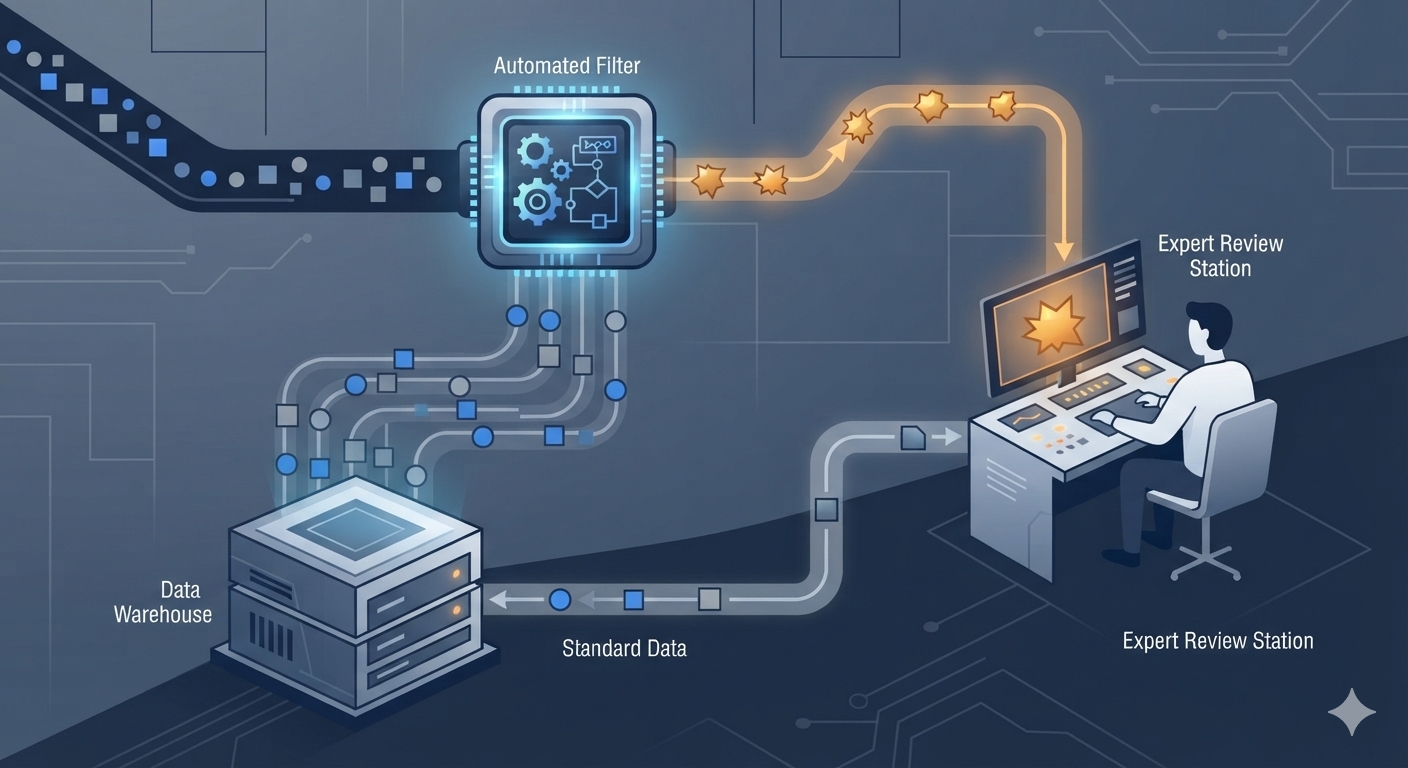
Addressing rare inputs requires balancing scale and precision. Engineering teams often debate whether to rely on automated edge-case handling in AI training or to depend entirely on human review. In practice, high-accuracy pipelines combine both techniques through a phased funnel.
| Capability | Automated Model-Assisted Flagging | Manual Expert Verification |
|---|---|---|
| Primary Mechanism | Uncertainty estimation, entropy scores, out-of-distribution (OOD) clustering. | Domain-specialist inspection, multi-pass review, cross-sensor contextualization. |
| Throughput | High; evaluates millions of unlabelled data points per hour. | Targeted; focused on low-volume, high-consequence edge cases. |
| Primary Strength | Rapidly isolates the lowest 1–5% confidence tail from raw data streams. | Resolves subjective nuances, subtle occlusions, and multi-modal discrepancies. |
| Common Limitation | Prone to false positives and susceptible to aleatoric (data noise) uncertainty. | Higher unit cost; requires precise taxonomy guidelines and expert calibration. |
Relying solely on automated heuristics often results in noise being mistaken for genuine edge cases. Conversely, having human annotators manually scan millions of regular samples in search of rare outliers is economically non-viable. The ideal workflow uses algorithmic filters to surface high-loss candidates, followed by trained specialists who apply rigorous domain rules.
7 Proven Ways to Master Edge Case Annotation
To move beyond ad-hoc data fixes, machine learning and data engineering teams can implement these seven structural strategies to handle edge cases across computer vision, sensor streams, and NLP pipelines.
1. Deploy Uncertainty-Based Active Learning Funnels
Rather than randomly sampling production data for labeling, leverage active learning to extract candidate edge cases automatically. Calculate predictive entropy, softmax margin scores, or Monte Carlo dropout variance across unlabelled data pools. Data points where the model shows high epistemic uncertainty—meaning it lacks sufficient training examples in that parameter subspace—should be tagged and prioritized for human annotation. Tools like Label Studio provide programmatic interfaces to integrate these active learning loops directly into human labeling queues.
2. Establish a Tiered Human-in-the-Loop (HITL) Validation Framework
Not all edge cases require the same level of domain knowledge. A robust HITL architecture routes anomalies based on task complexity:
- Tier 1 (General Annotators): Handle straightforward boundary resolutions, such as adjusting standard semantic segmentation masks around minor object occlusions.
- Tier 2 (Senior QA Specialists): Review ambiguous bounding boxes, novel sensor artifacts, or low-contrast items.
- Tier 3 (Domain Experts): Dedicated specialists—such as board-certified radiologists for medical annotation or certified ADAS safety engineers—who make determinations on ambiguous pathology or atypical road hazards.
This tiered routing ensures that expensive domain experts spend time exclusively on high-impact edge cases, while standard annotation remains cost-effective.
3. Standardize Dynamic Ontologies and Living Guideline Repositories
Static labeling guidelines quickly become obsolete when exposed to unpredictable edge cases in production. When teams are figuring out how to handle edge cases in dataset annotation for machine learning, the first breakdown often happens in the rulebook. If an annotator encounters an e-scooter carrying oversized cargo, does it classify as a pedestrian, a bicycle, or an obstacle?
Maintain an evolving edge case taxonomy with versioned photographic and textual references. When a novel scenario is approved by engineering leads, update the annotation manual immediately, complete with counter-examples showing what not to label.
4. Integrate Rigorous ISO 27001 Security Protocols During Outlier Curation
Edge cases often surface from unexpected real-world situations, meaning they frequently contain sensitive personal data, unmasked faces, unexpected geographic coordinates, proprietary device telemetry, or protected health information (PHI). Curating and isolating these data points creates heightened security risks.
To maintain regulatory compliance and customer trust, all edge case curation must adhere to strict information security management standards, such as ISO/IEC 27001. This requires:
- Role-based access control (RBAC) ensuring that sensitive outlier subsets are restricted to vetted, background-checked annotators.
- Secure virtual desktop environments with watermarking, disabled local downloads, and screen capture prevention.
- Automated PII scrubbing pipelines that remove personal identifiers prior to semantic labeling, unless the anomaly itself pertains to identity verification.
5. Exploit Multi-Modal Cross-Referencing
Visual ambiguity can often be resolved by cross-referencing auxiliary sensor streams. In autonomous systems, camera lenses can be blinded by lens flare, heavy rain, or sudden glare. By cross-referencing camera feeds with synchronized 3D point clouds via LiDAR and RADAR annotation, annotators can verify spatial geometry and object boundaries that are invisible in 2D RGB frames.
Similarly, in natural language processing, ambiguous transcriptions can be resolved by listening to acoustic pitch, pauses, and cadence in the raw audio stream rather than inspecting text tokens in isolation.
6. Close the Loop with Production Retraining Feedback Loops
Edge case annotation should not end once the dataset is exported. Build programmatic tracking between edge cases flagged in production and the training registry:
- Telemetry flags an inference failure or low-confidence event in production.
- The telemetry packet is automatically isolated, scrubbed of PII, and placed in the triage queue.
- Annotators label the sample according to edge case guidelines.
- The newly labeled sample is pushed to a dedicated regression test set to confirm the model learns the behavior without breaking performance on baseline distributions.
7. Augment Edge Samples with Targeted Synthetic Variations
Because rare edge cases may only appear a handful of times in natural operations, labeling a single real-world instance is rarely enough for a neural network to generalize. Once an edge case is verified by human annotators, use that verified ground truth to guide synthetic generation or targeted perturbations.
For instance, if an ADAS perception model fails on an overturned vehicle on a highway, annotating that single instance provides a baseline. Engineering teams can then render that annotated object under varying lighting conditions, weather simulations, and angles, turning one hard-won edge case into hundreds of reliable training variations.
Workflow: Feeding Flagged Edge Cases Back to Active Pipelines
To demonstrate identifying and annotating rare edge cases in practice, consider an autonomous delivery robot navigating complex sidewalks for autonomous vehicles deployment. Below is a concrete workflow for processing and resolving visual anomalies:
- Detection: The robot encounters a child walking a dog on an unusually long, thin leash across a sidewalk. The perception model detects the child and the dog with high confidence, but the leash scores below the detection threshold. The robot stops due to proximity sensor triggers, registering a planner conflict.
- Triage & Isolation: The system logs an OOD event. Telemetry captures the 5-second video buffer and LiDAR point cloud, transmitting the bundle to an ISO 27001-compliant storage bucket.
- Human Verification: The edge case queue delivers the synchronized multi-sensor frame to a senior annotator. The specialist uses polyline annotation to trace the thin leash and updates the spatial relationship attribute between the child and dog entities.
- Guideline Propagation: The QA lead creates an entry in the taxonomy documentation: “Long-lead tethers and extended leashes spanning traversal paths.”
- Regression Benchmarking: The annotated instance is placed in the safety-critical validation suite. The retrained model must successfully segment both the entities and the intervening tether before deployment approval.
Frequently Asked Questions
Why does AI struggle with edge cases?
Machine learning models rely on statistical distributions learned from training data. When a real-world input lies in the extreme tails of that distribution—or outside it entirely—the model lacks sufficient prior activation paths to make an accurate prediction. Without dense representations of those features, models default to nearest-neighbor generalizations, which often lead to incorrect inferences.
What are the main 3 types of ML models?
The three primary categories of machine learning are supervised learning (models trained on explicitly labeled input-output pairs), unsupervised learning (algorithms that discover intrinsic patterns and clusters without human-provided labels), and reinforcement learning (agents that learn optimal decision-making policies through trial-and-error interactions and environmental rewards).
What are examples of edge cases?
Examples vary across industries:
- Computer Vision: An emergency vehicle driving on the wrong side of the road against bright morning glare, or an overturned truck whose geometry does not resemble standard vehicles.
- Healthcare: A rare co-occurrence of multiple atypical lesions overlapping in low-resolution scans.
- Natural Language Processing: A customer support query blending multiple colloquial dialects, slang, and heavy sarcasm within a single sentence.
What is edge case handling?
Edge case handling refers to the end-to-end operational, engineering, and data annotation workflows designed to detect, curate, accurately label, and retrain machine learning systems on rare or unexpected outlier inputs. The goal is to harden models against brittle real-world behavior and prevent safety or operational failures.
Building Robust Production Models
Managing rare data distributions is not a one-time project; it is an ongoing requirement of production AI lifecycle maintenance. Systematically identifying anomalies, enforcing rigorous multi-tier human review, and maintaining strict information security protocols ensures models remain accurate and resilient when confronted with unexpected inputs.
If your team is scaling proprietary models and needs expert support with complex, multi-sensor, or sensitive data distributions, contact Annotation World to discuss specialized, ISO 27001-compliant data labeling workflows.