
Budgeting for training data is one of the most unpredictable phases of taking a model from research into production. While computing costs scale predictably with GPU cluster hours, the data annotation cost frequently expands beyond initial engineering forecasts. Unplanned edge cases, schema adjustments, multi-tier quality assurance, and domain-specific labor often trigger budget overruns that delay model deployment.
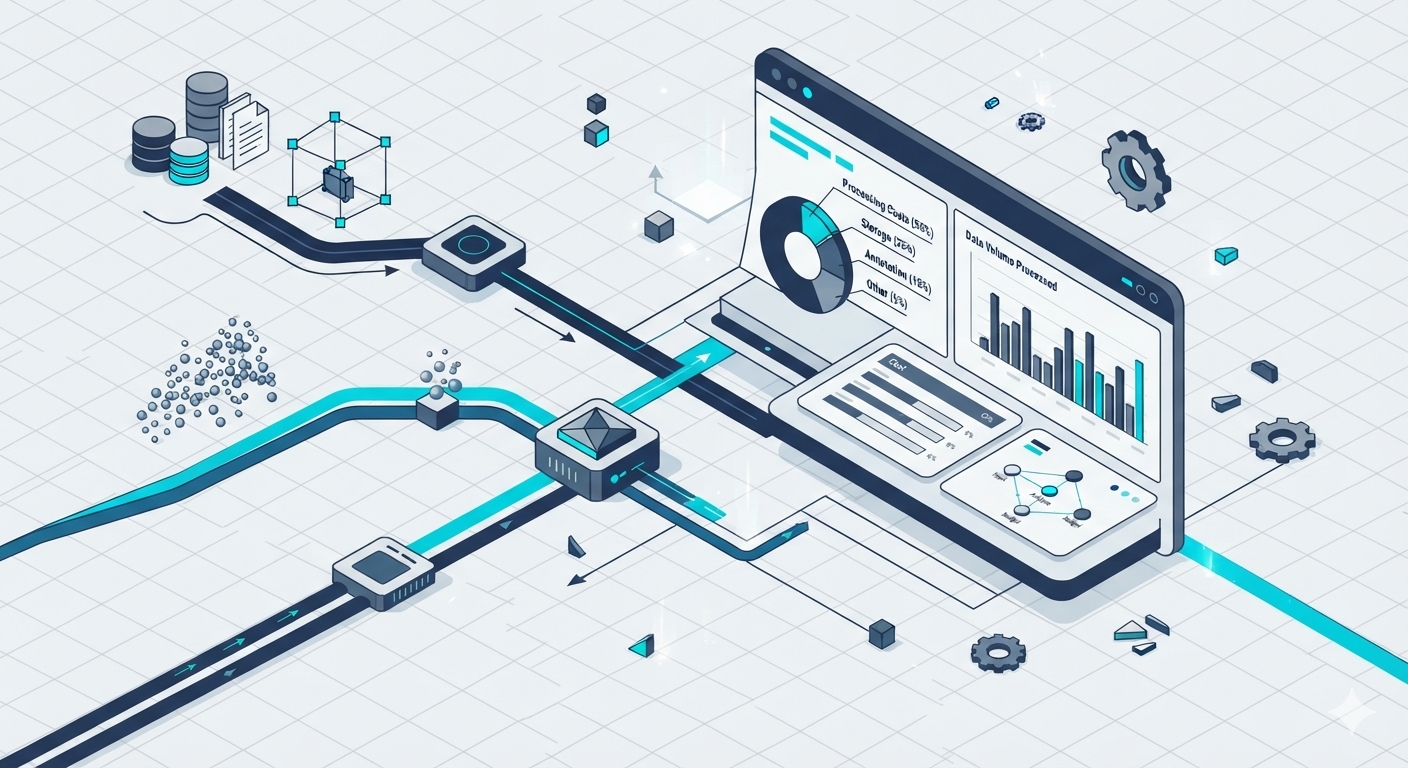
Accurately predicting your machine learning dataset cost requires moving past vague per-label estimates and treating data collection and labeling as an engineering system. This guide provides a five-step framework to budget your ML data pipeline, complete with a mathematical formula, modality breakdowns, and a vendor evaluation rubric.
Understanding Data Annotation Pricing Models
Before building your budget, you need to understand how labeling vendors and internal operations structure their pricing. Most engagements fall into three primary data annotation pricing models:
- Per-Task (Unit-Based) Pricing: You pay a fixed price per annotated image, bounding box, audio clip, or text document. This model offers predictable costs for standard computer vision tasks with well-defined schemas. However, if sample complexity varies widely, vendors often price in a risk premium to protect their margins.
- Hourly Rate Pricing: You pay for labeler hours worked. This approach is common in exploratory research, complex document reasoning, and early-stage computer vision tasks where guidelines change weekly. The risk shifts to the buyer, requiring active workforce management to maintain throughput.
- Dedicated Workforce (FTE Model): You contract a dedicated team of labelers, QA leads, and project managers on a monthly retainer. This model yields the lowest unit costs at high volumes, supports deep domain training, and integrates well into continuous active learning pipelines.
5 Steps to Calculate and Control Your Data Annotation Cost
Step 1: Quantify Volume and Modality-Specific Complexity
Annotation costs scale with cognitive load and task duration rather than raw sample count alone. Simple 2D bounding boxes require fractions of a second, whereas voxel-level point cloud segmentation or clinical diagnostic reviews require substantial time.
When assessing your dataset requirements, divide tasks by sensory modality and annotator skill requirements:
| Data Modality | Task Complexity | Typical Annotator Profile | Key Cost Drivers |
|---|---|---|---|
| 2D Computer Vision | Bounding boxes, polylines, semantic segmentation | Trained generalists | Object density per frame, occlusion levels, pixel-boundary precision |
| 3D Point Clouds & Sensor Fusion | LiDAR and RADAR cuboids, multi-frame tracking | Specialized spatial annotators | Sensor calibration complexity, point density, frame-to-frame interpolation |
| Text & NLP | NER, sentiment, conversation parsing, natural language processing workflows | Linguists, domain specialists | Document length, specialized jargon, multi-turn dialogue context |
| Healthcare & Life Sciences | Pathology segmentation, DICOM classification, medical annotation | Radiologists, MDs, certified technicians | Accreditation rates, regulatory compliance, multi-observer consensus |
Step 2: Account for Hidden Cost Drivers
Teams that evaluate only baseline unit rates frequently exceed their budgets due to four underreported expenses:
- Rework and Guideline Drift: As data science teams review early validation losses, annotation schemas frequently shift. A 10% change in edge-case taxonomy can trigger rework across 30% of previously approved assets.
- Inter-Annotator Agreement (Consensus Scoring): For subjective or high-stakes tasks, running duplicate annotations to measure Fleiss’ Kappa or Cohen’s Kappa doubles or triples the baseline labeling requirement for that sample slice.
- Tooling and Platform Licensing: Whether using self-hosted platforms via tools like CVAT or commercial workflow software, factor in user seat licenses, cloud egress, and data storage costs.
- Information Security & Compliance: Regulated industries require certified physical and digital security. Ensuring protocols adhere to ISO/IEC 27001 standards for data security adds operational overhead but prevents catastrophic breach liabilities.
Step 3: Apply the Formula for Machine Learning Dataset Cost
To master how to calculate annotation cost for machine learning projects, use a holistic mathematical model instead of a simple unit-times-quantity calculation. The following formula accounts for raw throughput, multi-tier quality assurance, expected rework, and operational management:
Total Project Cost = Cbase + CQA + Crework + Cops
Where each component is defined as:
- Cbase (Base Labeling):
Volume × Average Handling Time (Hours) × Labor Hourly Rate - CQA (Validation Overhead):
Cbase × QA Audit Percentage × (Auditor Hourly Rate / Labor Hourly Rate) - Crework (Error Correction):
Volume × Historical Rejection Rate × Time to Correct (Hours) × Labor Hourly Rate - Cops (Management & Tech):
Platform Fees + Project Management Hours + Pipeline Integration Overhead
Hypothetical Example: Budgeting an autonomous driving perception task consisting of 50,000 camera frames with high-density semantic segmentation. If each frame requires 0.25 hours (15 minutes) of labeling at $8/hour, the base cost is $100,000. Adding a 20% QA audit sample ($20,000), an estimated 8% rework rate ($8,000), and $12,000 in dedicated pipeline management and platform licensing yields an actual project requirement of $140,000—40% higher than the naive base estimate.
Step 4: Establish an Outsource vs. In-House Financial Model
When analyzing outsourcing data labeling cost versus building an internal labeling team, consider total cost of ownership (TCO). In-house teams eliminate vendor margins and protect intellectual property but introduce significant organizational overhead:
- In-House Operations: Require direct management, recruiting pipelines, workforce turnover mitigation, workstation hardware, and QA tooling maintenance. This approach works best for core intellectual property with proprietary domain logic.
- Outsourced Partners: Absorb operational turnover, scale headcounts dynamically, and distribute software licensing over multiple clients. This approach is most cost-effective when guidelines are documented and throughput needs fluctuate.
Step 5: Normalize Vendor Proposals on a Like-for-Like Basis
When collecting quotes from external labeling vendors, surface hidden variances by demanding structured, line-item pricing. Use this verification checklist before signing an SOW:
- Is QA included or billed separately? Clarify whether the quoted rate includes internal validation or if quality audits add a secondary hourly charge.
- What is the acceptance threshold? Specify the target quality metric (e.g., 98% IoU or 95% precision) and confirm who covers rework costs if batches fall below this standard.
- Are edge-case review cycles capped? Establish how long annotators spend on ambiguous samples before routing them to your internal ML engineering team.
- What are the data transfer and setup fees? Ensure ingestion from private cloud storage buckets (e.g., AWS S3, Google Cloud Storage) carries no unexpected egress or API charges.
Optimizing Long-Term Labeling Budgets
Controlling data spend over a model’s lifecycle requires technical optimization, not just negotiating vendor rates. Modern ML operations control expenses through targeted engineering practices:
- Model-Assisted Pre-Labeling: Run zero-shot foundations or early model checkpoints over raw datasets to populate initial bounding boxes or token labels. Human reviewers then switch from drafting to verification, reducing handling times by 30% to 60%.
- Active Learning Selection: Instead of labeling sequential frames or random document batches, use uncertainty sampling to annotate only the high-entropy samples that lie close to the model’s decision boundaries.
- Clear Annotation Manuals: Investing 20 engineering hours into edge-case documentation and golden benchmark datasets before launching labeling reduces rework rates across the entire lifecycle.
Ready to structure your upcoming labeling campaign with predictable economics and enterprise-grade data security? Contact our data solutions team to scope your pipeline requirements and benchmark your project costs.
Frequently Asked Questions
How much does an annotation cost?
Data annotation costs vary from $0.02 to well over $100 per asset, depending entirely on data modality and required expertise. Standard 2D bounding boxes on everyday objects cost between $0.03 and $0.15 per object. Complex 3D LiDAR point cloud tracking ranges from $2 to $12 per frame, while specialized medical image segmentation by credentialed radiologists can range from $25 to $100+ per scan.
What is the formula for calculating the cost function in machine learning?
In machine learning theory, the term “cost function” (or loss function) refers to an algorithmic metric that quantifies model prediction error, not financial expenditure. For example, the Mean Squared Error (MSE) cost function for regression tasks is formulated as:
J(θ) = (1 / 2m) × Σ (h_θ(x^(i)) - y^(i))²
For financial budgeting of machine learning data, project leads use operational accounting formulas that calculate total expense as a function of sample volume, handling time, QA ratios, rework rates, and management overhead.
What are annotations in machine learning?
Annotations are ground-truth metadata tags assigned to raw, unstructured data—such as images, text, sensor streams, or audio recordings—to make them interpretable by supervised machine learning algorithms. Examples include bounding boxes around pedestrians for autonomous driving models, semantic class labels on medical scans, or named-entity tags in legal contracts.
What is the hourly rate for data annotation?
Hourly rates for data annotation vary based on geography and skill specialization. General data labeling performed by trained workforces in offshore centers typically ranges from $3 to $10 per hour. Nearshore and domestic general labeling runs between $15 and $30 per hour. Highly specialized technical, linguistic, or medical annotation performed by licensed clinicians or subject matter experts ranges from $50 to $150+ per hour.