
When structuring a machine learning lifecycle, engineering leads and data operations managers inevitably face a pivotal architectural decision: deploy self-hosted open source data annotation tools or invest in commercial labeling software and managed services. On paper, community-driven software seems frictionless and free. However, the reality of deploying models into production reveals trade-offs spanning infrastructure costs, data governance, and operational scalability.
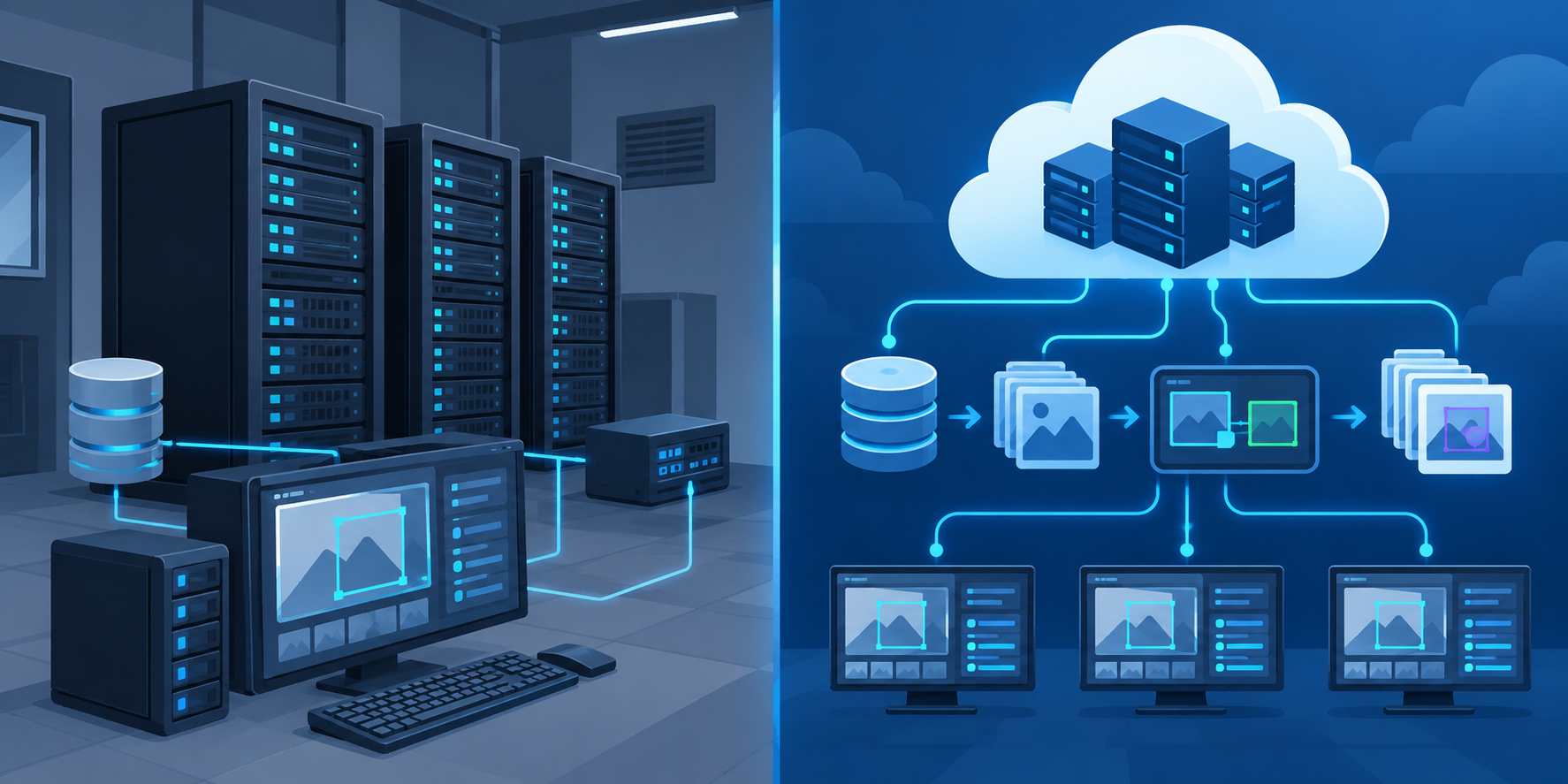
Evaluating open source data annotation tools vs commercial platforms requires looking beyond software license tags. It demands calculating the total cost of engineering time, regulatory liabilities, multi-modal sensor requirements, and workforce quality control at scale.
Open Source Data Annotation Tools: 7 Strategic Differences
Whether evaluating popular options like CVAT and Label Studio or proprietary enterprise platforms, these seven technical and operational dimensions dictate production success.
1. Total Cost of Ownership (TCO) and Engineering Overhead
Open source platforms carry zero upfront licensing costs, making them appealing for academic research and early prototyping. However, calculating data annotation software cost vs features requires modeling the Total Cost of Ownership (TCO):
- Hosting and Compute: Self-hosting computer vision labeling tools requires provisioning scalable cloud infrastructure (such as AWS EC2 instances, S3 buckets, and PostgreSQL databases), which scales directly with dataset size and concurrent users.
- DevOps and Maintenance: Engineering teams must manage software updates, security patches, container orchestration (Docker/Kubernetes), and database migrations. A senior ML engineer spending 10 to 15 hours a week maintaining internal annotation pipelines redirects high-value resources away from core model development.
- Downtime and Latency: Without dedicated infrastructure tuning, self-hosted instances can suffer performance bottlenecks during large video or point-cloud uploads, directly stalling annotator productivity.
Commercial platforms package these operational burdens into predictable SaaS pricing or turnkey service contracts, shifting maintenance overhead entirely off your engineering team.
2. Data Privacy, Security, and Compliance Governance
Data governance is often the dividing line between experimental AI and regulated enterprise deployments. Open source data labeling platforms give you complete control over network isolation because data never leaves your VPC. However, that isolation places the entire compliance burden squarely on your internal IT team.
If you process regulated data—such as Protected Health Information (PHI) in medical annotation or personally identifiable customer attributes—your self-hosted deployment must be manually hardened to comply with HIPAA, SOC 2, or GDPR requirements. Achieving and auditing compliance demands comprehensive audit logging, granular role-based access control (RBAC), and encrypted storage at rest and in transit.
By contrast, enterprise commercial providers are frequently certified against standards such as ISO/IEC 27001. These platforms provide out-of-the-box data isolation, single sign-on (SSO), comprehensive access logs, and formal Data Processing Agreements (DPAs) that satisfy enterprise procurement and compliance audits.
3. Workforce Management and Enterprise Scalability
An annotation tool is only as effective as the team operating it. Open source tools are fundamentally built as annotation interfaces rather than workforce operations engines. They typically offer basic user roles (e.g., admin, user), but struggle to manage distributed teams of 20, 50, or 200 annotators.
Commercial labeling ecosystems integrate dedicated workforce operations capabilities, including:
- Dynamic task routing based on annotator performance and skill ratings.
- Automated workload balancing to prevent project bottlenecks.
- Real-time hourly productivity tracking and task-completion metrics.
- Built-in micro-task distribution to prevent annotators from accessing full datasets out of context.
Attempting to run large-scale labeling campaigns in open source tools without these workforce management features often forces teams to track progress via external spreadsheets, introducing significant human error.
4. Quality Control, Consensus, and Agreement Scoring
In production ML, label noise directly degrades model convergence. Maintaining high quality requires sophisticated quality control (QC) workflows that go beyond simple manual spot-checking.
In CVAT vs commercial annotation tools evaluations, QC features are a major differentiator. While open source tools support basic review-and-reject loops, enterprise platforms offer programmatic validation systems:
- Inter-Annotator Agreement (IAA): Automated calculation of metrics such as Cohen’s Kappa or Intersection over Union (IoU) across multiple annotators labeling the same tasks blindly.
- Gold Standard Benchmarks: Hidden control tasks interspersed into active queues to automatically measure individual accuracy against known ground truths.
- Multi-Tiered Review Pipelines: Configurable, multi-stage approval funnels where flagged, high-ambiguity assets automatically escalate to senior domain specialists.
For complex tasks like pixel-level semantic segmentation, automated consensus algorithms are essential for eliminating subjective edge cases.
5. Complex Multi-Sensor and Domain-Specific Formats
Standard open source tools excel at 2D bounding boxes, polygon masks, and basic named entity recognition (NER). However, cutting-edge AI architectures increasingly rely on non-standard, multi-modal data streams.
Industrial applications—such as autonomous driving perception or robotics—require synchronous calibration across cameras, radar, and 3D point clouds. Labeling spatial frames in LiDAR and RADAR annotation requires specialized 3D cuboid projection, multi-sensor frame fusion, and temporal tracking across point sequences.
Similarly, medical image labeling requires native rendering for 3D volumetric DICOM or NIfTI series with adjustable windowing (Hounsfield units). While open source plugins exist, commercial tools deliver purpose-built viewing engines optimized to render high-throughput volumetric and spatial formats without browser crashes or severe memory leaks.
6. Tooling Extensibility vs. Engineering Maintenance Debt
Open source software gives your developers full access to the source code, allowing your team to build bespoke features, custom annotation UI elements, or specialized export scripts. For novel research, this flexibility is invaluable.
However, modifying an open source codebase creates a long-term maintenance fork. Every time the upstream repository releases a critical bug fix or security patch, internal engineers must resolve merge conflicts and verify that custom features remain compatible. Commercial platforms minimize this friction by offering stable REST APIs, Python SDKs, and webhook ecosystems. These programmatic interfaces allow ML teams to integrate continuous data pipelines without maintaining internal forks of the labeling interface.
7. Enterprise SLAs, Product Roadmaps, and Support
When an open source labeling server crashes or encounters corrupted annotation exports, resolution depends entirely on your internal engineers or community forums. There are no uptime guarantees, priority hotfixes, or dedicated account managers.
For time-sensitive commercial projects, unplanned labeling downtime translates to idle operations teams and delayed deployment schedules. Commercial vendors provide formal Service Level Agreements (SLAs), enterprise uptime guarantees, dedicated technical onboarding, and guaranteed escalation paths to resolve data ingestion or software issues promptly.
Comparison Overview: Open Source vs Commercial Platforms
| Evaluation Dimension | Open Source Annotation Tools | Commercial Annotation Platforms |
|---|---|---|
| Software License Cost | Free / Open Source (e.g., MIT, Apache 2.0) | Subscription (SaaS) or usage-based pricing |
| Infrastructure Costs | High; paid by you (compute, storage, backups) | Included in SaaS hosting fees |
| DevOps Overhead | High; ongoing internal maintenance required | Zero; fully managed by vendor |
| Security & Certifications | Self-configured; internal compliance audit required | Pre-certified (e.g., ISO 27001, SOC 2, HIPAA readiness) |
| Workforce Management | Basic task assignments and permissions | Advanced routing, real-time metrics, role isolation |
| Quality Assurance (QA) | Manual spot checks, basic review queues | Consensus scoring, blind gold tasks, automated IoU checks |
| Multi-Sensor Support | Limited or requires custom community extensions | Native 3D point cloud, multi-sensor fusion, DICOM support |
Frequently Asked Questions
What are the best open source tools for image annotation?
The most widely deployed open source image annotation tools are CVAT (Computer Vision Annotation Tool), Label Studio, and Labelme. CVAT is particularly suited for object detection, segmentation, and video interpolation. Label Studio provides broad multi-modal flexibility across image, audio, text, and time-series data. Labelme is a lightweight Python-based tool commonly used for basic polygon labeling in academic settings.
How much does CVAT cost per month?
CVAT is free to download, self-host, and modify under its open source license. However, its commercial SaaS cloud offering (managed by CVAT.ai) provides tiered pricing, including a free tier with usage limits and paid professional plans typically starting around $33 to $40 per user per month. Self-hosted instances carry no software fees, but require budgeting for cloud compute, storage, and administrative engineering time.
Are there other platforms like data annotation?
Yes. Depending on whether your organization needs software platforms or managed workforce services, several alternatives exist. Software-focused platforms include Labelbox, Encord, V7, and Kili Technology. Organizations looking for managed, turnkey annotation teams often partner with dedicated, certified data labeling service providers that combine secure tooling with professional annotation workforces.
What are the four types of annotations?
In machine learning, the four most common data annotation types are:
- Bounding Boxes: Rectangular 2D or 3D boxes used to localize objects in computer vision.
- Semantic Segmentation: Assigning a specific class to every individual pixel in an image for precise boundary recognition.
- Keypoint Annotation: Pinpointing specific landmark coordinates to detect structural points, facial features, or human pose estimation.
- Text and Entity Labeling: Categorizing spans of text, tokens, or intent in Natural Language Processing (NLP) datasets.
Choosing the Right Approach for Your Pipeline
Open source data labeling platforms serve an essential purpose: they enable researchers, academics, and early-stage projects to validate ideas without software licensing hurdles. However, as AI initiatives transition into production environments handling high-volume datasets, complex multi-sensor streams, and strict security mandates, the hidden costs of self-hosted infrastructure and internal tool maintenance often outstrip commercial solutions.
If your team requires enterprise-grade quality control, verifiable data security, and end-to-end operational efficiency, explore how our ISO 27001:2013 certified annotation teams can accelerate your pipeline. Contact our specialists today to design an annotation workflow tailored to your production ML models.